
August 4, 2026

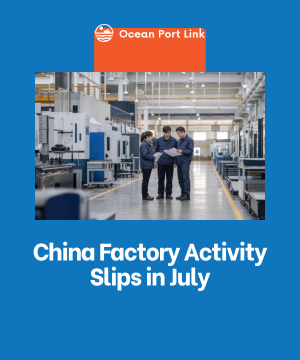
China's official manufacturing purchasing managers' index (PMI) fell to 49.2 in July, down from 50.3 in June. For Australian importers, the practical message is not “China is cheaper now”. It is: re-test your supplier's capacity, quotation assumptions and delivery plan before committing the next order.

The national figure moved below the 50-point line that separates expansion from contraction. New orders dropped to 48.5 from 51.2, while production fell to 49.9 from 51.4. That is a clear loss of momentum, but it remains a broad survey rather than evidence about any individual factory.

What the July PMI says — and what it does not

PMI surveys ask purchasing managers whether business conditions improved, deteriorated or stayed the same compared with the previous month. China's official survey covers 3,200 manufacturers across 31 industries, making it useful as an early directional signal.

July's reading indicates that manufacturing conditions contracted overall after returning to expansion in June. The fall in new orders was particularly notable because it points to softer demand entering factories, not just a change in finished output.

However, a national reading of 49.2 does not mean every supplier is quiet. A specialised export factory may still be full, a commodity-intensive product may still face higher input costs, and weather or seasonal shutdowns may affect regions differently. Importers should use the index to ask better questions, not to dictate an unsupported discount.

Five checks to make with your supplier now

1. Ask for a dated production plan

Request the proposed production start, major process stages, inspection window and ex-factory date in writing. If a supplier says capacity is tight, ask which step is constrained and whether the bottleneck is labour, tooling, materials or subcontracting.

This turns a vague lead-time promise into a schedule that can be monitored.

2. Reconfirm what the quotation includes

Check the unit price, tooling, packaging, labelling, testing, inland transport and export charges. Confirm the currency, Incoterm, quotation expiry date and the assumptions that allow the supplier to change price.

A softer factory market may create room for better terms, but an unexplained low quote can simply move cost or risk somewhere else.

3. Negotiate commercial terms, not only unit price

Useful concessions can include a lower minimum order quantity, a smaller deposit, staged production releases, free pre-production samples, improved packaging, or payment linked to a passed inspection.

For many importers, these changes reduce cash-flow and quality risk more effectively than a small headline discount.

4. Test the lead time with evidence

Ask whether materials are in stock, when they will be ordered, and how long each production step normally takes. For repeat orders, compare the new schedule with the supplier's actual performance on earlier orders.

If the factory offers a much shorter lead time, make sure quality-control stages have not quietly disappeared.

5. Protect the specification before paying a deposit

Reissue the approved drawings, materials, tolerances, colours, packaging and test requirements with a revision date. Require the supplier to acknowledge the exact version that controls production.

Changing market conditions can improve negotiating leverage, but they do not repair an ambiguous specification.

What else changed this week

OPL's review of the Australian Department of Agriculture's 2026 Import Industry Advice Notices did not identify a new notice dated between 28 July and 3 August. No material customs or anti-dumping development for the broad China-Australia importer audience was validated for the same window.

Container markets remain worth watching, but the latest usable Drewry World Container Index item predates this brief and covers major east-west trades rather than the China-Australia lane specifically. OPL therefore has not treated it as evidence that an Australian importer's next freight quote should move by the same amount.

The practical takeaway

China's July PMI gives importers a reason to reopen the supplier conversation. The strongest approach is evidence-led: validate the production plan, lock the specification, clarify price assumptions and negotiate terms that reduce cash-flow or quality risk.

Do not assume a national slowdown guarantees a cheaper order. Use it to find out whether your supplier's real position has changed.

If you are preparing a China-to-Australia order and want the supplier quote, production controls and freight assumptions reviewed together, Ocean Port Link can help structure the next step.

China-Australia Import Brief: 28 July-3 August 2026

Shabahat, Ocean Port Link sourcing expert
Shabahat Ali
August 4, 2026
China-Australia Import Brief: 28 July-3 August 2026
Table of Contents

China's official manufacturing purchasing managers' index (PMI) fell to 49.2 in July, down from 50.3 in June. For Australian importers, the practical message is not “China is cheaper now”. It is: re-test your supplier's capacity, quotation assumptions and delivery plan before committing the next order.

The national figure moved below the 50-point line that separates expansion from contraction. New orders dropped to 48.5 from 51.2, while production fell to 49.9 from 51.4. That is a clear loss of momentum, but it remains a broad survey rather than evidence about any individual factory.

What the July PMI says — and what it does not

PMI surveys ask purchasing managers whether business conditions improved, deteriorated or stayed the same compared with the previous month. China's official survey covers 3,200 manufacturers across 31 industries, making it useful as an early directional signal.

July's reading indicates that manufacturing conditions contracted overall after returning to expansion in June. The fall in new orders was particularly notable because it points to softer demand entering factories, not just a change in finished output.

However, a national reading of 49.2 does not mean every supplier is quiet. A specialised export factory may still be full, a commodity-intensive product may still face higher input costs, and weather or seasonal shutdowns may affect regions differently. Importers should use the index to ask better questions, not to dictate an unsupported discount.

Five checks to make with your supplier now

1. Ask for a dated production plan

Request the proposed production start, major process stages, inspection window and ex-factory date in writing. If a supplier says capacity is tight, ask which step is constrained and whether the bottleneck is labour, tooling, materials or subcontracting.

This turns a vague lead-time promise into a schedule that can be monitored.

2. Reconfirm what the quotation includes

Check the unit price, tooling, packaging, labelling, testing, inland transport and export charges. Confirm the currency, Incoterm, quotation expiry date and the assumptions that allow the supplier to change price.

A softer factory market may create room for better terms, but an unexplained low quote can simply move cost or risk somewhere else.

3. Negotiate commercial terms, not only unit price

Useful concessions can include a lower minimum order quantity, a smaller deposit, staged production releases, free pre-production samples, improved packaging, or payment linked to a passed inspection.

For many importers, these changes reduce cash-flow and quality risk more effectively than a small headline discount.

4. Test the lead time with evidence

Ask whether materials are in stock, when they will be ordered, and how long each production step normally takes. For repeat orders, compare the new schedule with the supplier's actual performance on earlier orders.

If the factory offers a much shorter lead time, make sure quality-control stages have not quietly disappeared.

5. Protect the specification before paying a deposit

Reissue the approved drawings, materials, tolerances, colours, packaging and test requirements with a revision date. Require the supplier to acknowledge the exact version that controls production.

Changing market conditions can improve negotiating leverage, but they do not repair an ambiguous specification.

What else changed this week

OPL's review of the Australian Department of Agriculture's 2026 Import Industry Advice Notices did not identify a new notice dated between 28 July and 3 August. No material customs or anti-dumping development for the broad China-Australia importer audience was validated for the same window.

Container markets remain worth watching, but the latest usable Drewry World Container Index item predates this brief and covers major east-west trades rather than the China-Australia lane specifically. OPL therefore has not treated it as evidence that an Australian importer's next freight quote should move by the same amount.

The practical takeaway

China's July PMI gives importers a reason to reopen the supplier conversation. The strongest approach is evidence-led: validate the production plan, lock the specification, clarify price assumptions and negotiate terms that reduce cash-flow or quality risk.

Do not assume a national slowdown guarantees a cheaper order. Use it to find out whether your supplier's real position has changed.

If you are preparing a China-to-Australia order and want the supplier quote, production controls and freight assumptions reviewed together, Ocean Port Link can help structure the next step.