

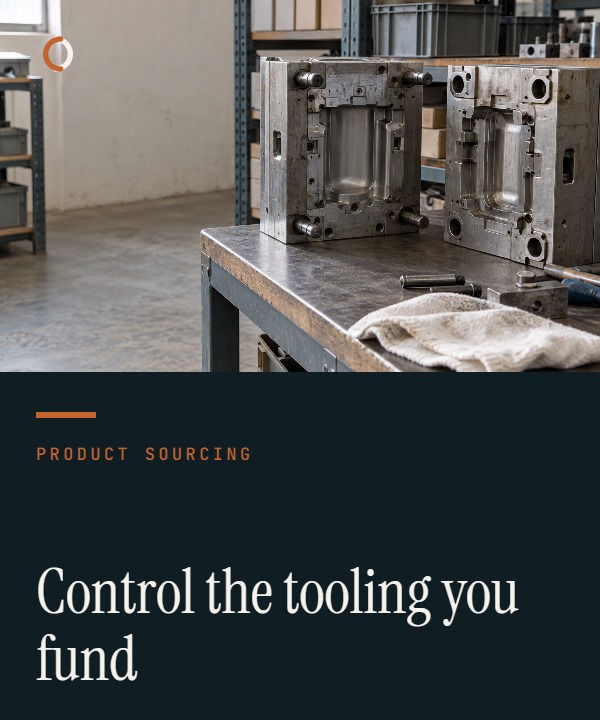
A quotation includes a substantial mould charge. The buyer pays it. Months later, the supplier relationship changes—and the buyer discovers that “tooling paid” never answered the practical questions.
Where is the mould? How is it identified? Which products and factories may use it? Who has the drawings and setup data? What condition is it in? Can it be inspected, transferred or retired? Who pays for maintenance? What happens after a design change?
Payment is one fact. Legal title, physical possession, authorised use, technical data and practical release are different facts.
Stop using “the mould” as the complete description
Custom tooling may include more than one asset:
- mould base, inserts and cavities;
- dies, jigs, fixtures and gauges;
- electrodes, masters or patterns;
- hot-runner, cooling or ejection components;
- control programs and process parameters;
- 2D drawings, 3D models and manufacturing data;
- spare and replaceable components; and
- inspection fixtures or reference parts.
The commercial record should define exactly what is being designed, manufactured, validated and retained. “One set mould” is rarely enough to verify delivery or condition.
Separate the control questions
| Question | Evidence to record | Risk if left implicit |
|---|---|---|
| Who funded it? | Tooling quotation, invoices and payment record | Payment may be confused with title or acceptance |
| Who claims legal title? | Agreement reviewed for the relevant jurisdiction | An operational note may be mistaken for an enforceable right |
| Who possesses it? | Named site, custodian and current location evidence | The buyer may not know which company physically holds it |
| Who may use it? | Authorised products, sites, quantities and users | Exclusivity may be assumed rather than defined |
| Who holds the data? | File register, format, revision and access | Tool transfer may be impractical without technical information |
| Who maintains it? | Maintenance plan, history and cost responsibility | Condition can decline without a visible owner |
| Who can release it? | Agreed process, authority and handover evidence | A title claim may not produce a workable transfer |
These rows should not be collapsed into the sentence “buyer owns tooling”. That wording may belong in a properly drafted agreement, but the project still needs physical identification, custody, access and release controls.
Define the tooling deliverable before paying for it
Start at quotation and design-for-manufacture review, not after the tool has been built.
Define:
- tool type and purpose;
- product and drawing revision;
- material or steel specification where material to performance;
- number of cavities and replaceable inserts;
- intended equipment and production site;
- expected validation evidence;
- included drawings, data and reports;
- spare components;
- marking and identification method;
- acceptance milestone;
- storage, maintenance and modification basis; and
- end-of-use or release process.
Do not prescribe tool life as an impressive round number without defining the operating conditions, maintenance and evidence. A quoted cycle expectation is not a guarantee and may not be comparable across different designs or processes.
If the supplier proposes a “soft”, prototype, bridge or production tool, record what the term means for this project. Tooling vocabulary is not universal.
Create a tooling register
Assign each asset a unique buyer-facing identifier before acceptance. Permanent marking may be useful where technically appropriate, but marking alone does not create title or guarantee access.
The register should contain:
| Field | Required record |
|---|---|
| Tool identity | Unique ID, tool type, product/SKU and drawing revision |
| Configuration | Cavities, inserts, components, material and key dimensions |
| Visual evidence | Dated overall and detail photographs showing the identifier |
| Location | Legal/operating entity, complete site and custodian contact |
| Validation | Trial date, sampled cavities, results and approved initial parts |
| Data package | Drawing/model/report names, formats, revisions and holder |
| Condition | Acceptance state, repairs, wear and open issues |
| Commercial status | Quotation, payments, unpaid balance and authorised changes |
Maintain history rather than overwriting the latest location or condition. A buyer should be able to reconstruct when the asset moved, changed or was repaired.
Tie tooling payments to defined evidence
A tooling schedule may contain design, material procurement, machining, assembly, trial and acceptance stages. The payment structure should reflect the actual project rather than a universal percentage.
Possible evidence gates include:
- completed DFM review against the released product revision;
- approved tool design or agreed design-review disposition;
- identified material or critical component evidence where justified;
- completed tool with permanent identifier and location record;
- trial parts from each relevant cavity;
- dimensional and functional results against the specification;
- documented corrections and retrial results; and
- accepted data and spare-component package.
A photograph of a mould does not prove steel grade, internal construction, ownership, condition or production capability. A conforming initial part is evidence only about the characteristics checked on that part at that time.
Connect the tooling payment record to the Chinese supplier payment-term method so each release is tied to identified tooling evidence. A legal adviser should review any provision intended to establish title, exclusivity, remedies or compulsory release.
Control authorised use without making unsupported accusations
Buyers reasonably want to prevent custom tooling from being used for unauthorised products or customers. The control should begin with clear scope and evidence, not assumptions about supplier intent.
Record:
- authorised products and revisions;
- approved production sites and subcontractors;
- permitted quantities or order references where relevant;
- access to production and maintenance records;
- treatment of trial, scrap and surplus parts;
- handling of confidential drawings and process data;
- notification and approval before movement or modification; and
- escalation route for unexplained use or location changes.
Anonymous online allegations cannot establish what a factory did. If evidence suggests unauthorised use, preserve records and obtain qualified legal advice before asserting infringement or a contractual breach.
Inspect condition and custody periodically
Tooling can remain unused for months between orders. A register created at acceptance becomes stale unless it is refreshed.
Use risk-based custody checks such as:
- dated photographs showing the unique identifier and current condition;
- confirmation of exact storage location and custodian;
- maintenance and preservation record;
- cycle or shot count where reliably available;
- damage, corrosion, repair or modification report;
- current configuration and insert inventory; and
- evidence after a factory, ownership or subcontractor change.
For high-value or critical tooling, an independent physical check may be justified. Define access before the relationship deteriorates.
Govern maintenance, repair and modification
The order documentation should identify:
- preventive maintenance responsibilities;
- routine consumables and replaceable components;
- damage assessment and approval route;
- quotation and authority for major repair;
- dimensional or production revalidation after material change;
- revision updates to drawings and the tool register; and
- responsibility for poor storage or unauthorised modification, subject to legal advice.
Do not allow an approved repair to become an undocumented design change. If the modification can affect fit, function, appearance, safety or production consistency, require defined revalidation and updated reference samples.
Plan release before a transfer is urgent
Tool transfer can involve heavy freight, lifting, preservation, technical data, export packaging, insurance, taxes, customs and the receiving factory's equipment. A legal right on paper does not automatically make the transfer fast, safe or economical.
An operational release plan can identify:
- release request and authorised contacts;
- inventory of tooling, inserts, spares and data;
- condition inspection before handover;
- outstanding repair or payment issues;
- preparation, rust protection and export packaging;
- lifting points, dimensions and gross weight;
- collection site and access requirements;
- data handover and deletion/retention record;
- receiving-party acknowledgement; and
- chain of custody.
Do not move or export a tool based on this checklist alone. Obtain China-qualified legal, tax, customs, logistics and technical advice appropriate to the asset and transaction.
Control retirement and destruction
If a tool will not be transferred or reused, define the retirement decision. Depending on the circumstances and qualified advice, the record may need to address:
- authority to retire;
- final inventory and condition;
- removal of identifying plates or confidential features;
- witnessed or evidenced destruction;
- metal or component disposal;
- treatment of drawings and electronic data; and
- retention of the closed record.
A supplier photograph labelled “destroyed” may be insufficient for a high-value or sensitive asset. The evidence level should match the commercial and IP risk.
Tooling-control checklist
- [ ] The tool and included components are defined beyond “one set”.
- [ ] Legal ownership language has been reviewed by appropriately qualified counsel.
- [ ] Funding, title claim, possession, permitted use, data and release are recorded separately.
- [ ] The tool has a unique identifier and dated photographic record.
- [ ] Product, drawing, cavity and site relationships are traceable.
- [ ] Payment milestones require defined engineering and acceptance evidence.
- [ ] Data formats, revisions, holders and delivery obligations are recorded.
- [ ] Use, movement, modification and subcontracting require defined authority.
- [ ] Maintenance, repair, condition and configuration history are retained.
- [ ] Custody is periodically reconfirmed according to risk.
- [ ] Release, transfer, storage and destruction processes are planned.
- [ ] Cross-border movement receives legal, customs, tax, logistics and technical review.
Control is built from records, access and enforceable advice
The buyer who funds a mould needs more than a line item and a promise that “it belongs to you”. The project needs a defined asset, unique identity, known location, validation record, permitted-use controls, maintenance history and workable release plan.
Those operational controls do not decide legal ownership. They make the facts visible and give qualified advisers a clearer foundation for agreements and action.
OPL helps Australian businesses specify, source and monitor custom tooling used in China manufacturing. Contact OPL before funding a new tool or changing suppliers.
Sources


