

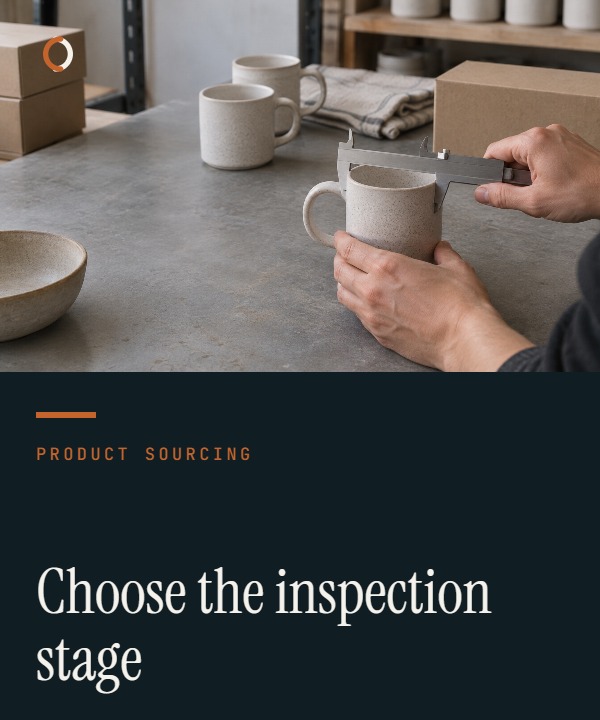
A pre-shipment inspection can find a finished product that is wrong. It cannot travel back in time to prevent the wrong material being assembled, the wrong colour being printed across an entire run or a process defect being repeated for three weeks.
The right inspection stage depends on the failure you are trying to control. Inspect when useful evidence exists and while the buyer still has practical options.
Decision rule: Choose inspection timing from the failure mode, not from the name of the inspection service.
The four common inspection stages
Established inspection providers commonly offer initial-production, during-production, final or pre-shipment, and loading checks. Their service names and completion thresholds vary. Treat the labels as an industry taxonomy, not universal technical definitions.
| Stage | Main question | Useful evidence | Important limitation |
|---|---|---|---|
| Initial Production Check (IPC) | Did the intended inputs and initial setup produce the right early output? | Materials/components, first production, setup, identity, schedule | Early units may not represent stable ongoing output |
| During Production Check (DUPRO) | Is the operating process producing conforming work while correction remains possible? | Work in progress, completed units, process consistency, schedule | Does not replace final finished-goods verification |
| Final Random Inspection (FRI/PSI) | Does the identified finished lot meet the agreed release protocol? | Product, quantity, workmanship, function, labels and packaging | Too late to prevent defects already multiplied |
| Container Loading Check (CLC) | Are the identified goods, counts and cartons loaded appropriately? | Container condition, quantity, carton identity, loading and seal record | Not a substitute for a full product inspection |
The point is not to book all four automatically. It is to place evidence before the decision becomes irreversible.
Use initial production checks for input and setup risk
An initial-production check is useful when the first output can reveal whether production began from the approved basis.
Typical questions include:
- Are the intended raw materials and components available and identifiable?
- Are the correct drawings, artwork and packaging revisions at the workstation?
- Is the approved tooling, cavity or fixture being used?
- Do first units meet critical dimensions, assembly and function requirements?
- Are known development corrections present in the production setup?
- Is the planned inspection and test equipment available?
IPC is especially valuable when a wrong input becomes hidden after assembly or expensive to replace later. Examples include an internal component, coating system, substrate, adhesive, insert, fabric construction or print setup.
It is not proof that the process will remain stable. Early units may be produced under special attention or trial conditions. Record the actual machines, operators, cavities, materials and departures used, then define what must be confirmed during production.
Use DUPRO when defects can multiply or the schedule can drift
A during-production inspection examines work in progress and completed units while the factory can still change the operating process.
It can answer:
- Is output staying within the released specification?
- Is one line, cavity, operator, colour or component source producing a different result?
- Are corrections from the initial check sustained?
- Are labelling, packaging and assortment being introduced correctly?
- Is actual output consistent with the reported schedule?
- Is an emerging defect concentrated in a particular production period?
DUPRO is useful for longer runs, repeated operations, multiple lines or cavities, handmade processes and products where rework becomes difficult after packing.
The buyer should define how work-in-progress and finished units will be selected. A convenient sample from one completed section may not represent the rest of the order.
Use final random inspection for the release-ready lot
Final inspection is the common pre-shipment gate because the product, labels, packaging and order quantities can be assessed together.
The lot should be sufficiently complete and accessible for the agreed sampling method. Provider completion thresholds are service conditions, not universal rules. The buyer needs enough finished, packed goods to make the defined population real and representative.
A final protocol may cover:
- product and revision identity;
- quantity and variant allocation;
- random sample selection;
- workmanship and agreed defect classes;
- dimensions and onsite functional tests;
- artwork, labels, warnings and barcodes;
- retail and export packaging;
- carton count, measurements and weight; and
- required documents or production records.
A final pass is evidence about the identified sample, lot and checks. It does not prove that every unit conforms, that unperformed tests would pass or that the goods later loaded are identical unless custody is controlled.
Use loading supervision for identity and handling risk
A container loading check focuses on the handover into transport.
It may record:
- container or vehicle condition;
- product and carton identity;
- quantities loaded;
- packaging damage before loading;
- loading sequence and handling;
- blocking, bracing or special instructions where defined;
- container number and seal; and
- departure evidence.
This can matter where substitution, mixed shipments, fragile cartons, high counts or container condition are material risks. QIMA expressly notes that loading checks are not as thorough as pre-shipment inspections and should not replace them.
Map each failure to the earliest useful evidence
| Failure mode | Earliest useful stage | Why | Later confirmation |
|---|---|---|---|
| Wrong material or component | IPC or incoming-control evidence | The input may become hidden after assembly | Traceability review or qualified testing |
| Tooling, cavity or setup error | IPC | First output exposes repeatable geometry or assembly error | DUPRO across affected sources |
| Process drift or workmanship variation | DUPRO | Trend is visible while settings and work can still be corrected | Final lot sampling |
| Finished function or cosmetic defects | DUPRO or FRI depending on process | Requires sufficiently complete units | FRI before release |
| Artwork, label or pack-out error | First packed unit or DUPRO | Repacking an entire lot can be costly | FRI across variants/cartons |
| Wrong quantity or assortment | DUPRO for progress; FRI for final lot | Early progress and final delivery are different questions | Loading count where justified |
| Loading damage, substitution or container condition | CLC | The risk occurs during handover | Receiving inspection in Australia |
The matrix is OPL's practical framework. Product design, process and consequence determine the answer; the same defect can require different timing in different industries.
Decide whether one stage is enough
One final inspection may be proportionate for a repeat order with stable inputs, controlled production, low complexity and reliable recent evidence. It may be weak for a first custom run with new tooling, critical materials, irreversible assembly and an untested pack-out.
Consider combining stages when several of these apply:
- new product, supplier, factory, line or tooling;
- important material or component cannot be verified after assembly;
- long production duration or multiple batches;
- multiple cavities, colours, sizes or subcontractors;
- high order value or schedule consequence;
- process is manual or sensitive to setup;
- product-safety or compliance evidence depends on production controls;
- earlier samples exposed unresolved production-representativeness gaps;
- repair becomes destructive after finishing or packing; or
- receiving failure would be commercially difficult to contain.
Do not translate this list into a mechanical count. Use it to expose where the current evidence path is weak.
Keep laboratory testing on its own track
Factory inspection and product testing overlap only where the onsite method is valid for the characteristic.
An inspector may verify dimensions, assembly, appearance or a defined functional cycle with suitable equipment. That does not automatically establish chemical composition, electrical safety, flammability, load life or conformity with a mandatory standard.
Australian guidance recommends testing custom-made exact models, product samples and ongoing production where appropriate. It also recommends reliable, preferably accredited laboratories for relevant testing. Determine the product's Australian compliance route separately and link it to production changes and sample selection.
Write the stage instruction as a decision brief
For every booked inspection, provide:
- inspection purpose and decision it supports;
- product, order and lot identity;
- applicable specification, artwork, packaging and sample revisions;
- population availability required;
- sample-selection rule;
- characteristic, method, tool and test subset;
- defect catalogue and sampling plan where used;
- evidence and photo requirements;
- known risks and previous corrections;
- blocked-test escalation;
- report status definitions; and
- authority for hold, clarification and release.
The inspection company should confirm that the visit can be performed as instructed. If the factory lacks a required fixture or the lot will not be ready, solve that before the inspector arrives.
A hypothetical first-run strategy
Consider a new custom storage product with injection-moulded parts, printed graphics and a fitted retail carton. This is illustrative, not a universal prescription.
- Initial production: confirm material identification, intended cavities, first-off fit and the approved artwork revision.
- During production: sample across cavities and production periods; check fit, surface, print consistency and correction of initial issues.
- Final inspection: apply the agreed lot sampling plan to finished products; verify variants, function, labels, retail pack and export cartons.
- Loading check, if justified: confirm the inspected order, carton count, container condition and seal.
Each stage removes a different uncertainty. Repeating the same cosmetic check four times would add cost without creating the same value.
Inspection-stage checklist
- [ ] The failure mode is defined before choosing the stage.
- [ ] The stage occurs when the requirement is observable.
- [ ] Corrective options remain open if the result fails.
- [ ] The available population supports representative selection.
- [ ] Product and document revisions are controlled.
- [ ] Tests, tools and subsets are confirmed before the visit.
- [ ] The stage does not substitute for required laboratory evidence.
- [ ] Earlier corrections are carried into later checks.
- [ ] Final release considers all open evidence, not one report heading.
- [ ] Loading identity and handling receive a separate decision where needed.
Inspect before the risk is locked in
The best inspection schedule is not the longest one. It is the schedule that produces decision-grade evidence at the points where failure can still be contained.
Check inputs and setup early, process behaviour while production can be corrected, the finished lot before release and loading where handover creates a separate risk. Then link every result to the same controlled specification and release authority.
OPL helps Australian businesses design production and inspection controls for goods sourced from China. Contact OPL before a first production run if the failure-mode timing is still unclear.
Sources


