

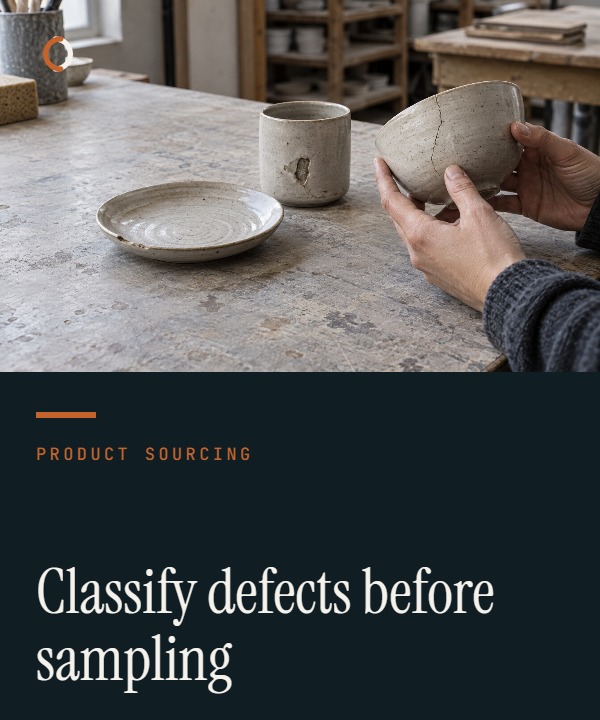
A scratch is not automatically minor. A loose component is not automatically critical. The correct classification depends on the product, location, intended use, applicable requirement and consequence.
That is why critical, major and minor defects must be defined before inspection. If severity is decided only after the report arrives, the labels become negotiating positions rather than controlled acceptance criteria.
Decision rule: Classify the consequence of the nonconformity, then define an observable boundary the supplier and inspector can apply consistently.
Defect classes are not universal product facts
ASQ describes defect classification as a listing of possible defects according to seriousness and notes that common systems include critical, major and minor. It also warns that the definitions require careful, product-specific preparation.
In a buyer's operating system, the classes often serve these roles:
| Class | Practical decision meaning | Examples of consequence to consider |
|---|---|---|
| Critical | Potential safety, regulatory or other consequence the buyer has defined as an overriding gate requiring immediate escalation | Injury risk, prohibited condition, unresolved mandatory requirement |
| Major | Material failure of intended function, assembly, saleability or customer use | Product does not perform its primary job, wrong variant, significant visible damage |
| Minor | Limited departure that does not materially impair intended use but still breaches an agreed requirement | Small workmanship deviation within an agreed minor boundary |
These are functional descriptions for building a catalogue, not declarations that a particular defect belongs in a class. The actual classification must be reviewed against the real product and current requirement.
Start with the controlled requirement
Do not classify “bad handle” or “poor finish”. Identify:
- product and SKU;
- specification, drawing, artwork or packaging revision;
- feature and location;
- nominal requirement and tolerance or approved boundary;
- intended and reasonably foreseeable use;
- applicable safety or regulatory requirement where relevant;
- approved physical reference or photographic example; and
- evidence method.
The nonconformity is the failure to meet that defined requirement. Severity describes the consequence of that failure for the buyer's decision.
Use five questions to classify severity
1. Could it create a safety or mandatory-compliance concern?
If yes or uncertain, stop routine classification and obtain suitable technical or regulatory review. An inspector should not infer Australian compliance from appearance alone.
Australian mandatory standards can address performance, composition, manufacture, design, construction, finish, packaging and labelling. Not every product has a product-specific mandatory standard, and the applicable rule must be established for the actual item.
2. Does it prevent the primary function?
A product that cannot perform its central purpose usually presents a materially different decision from one with a limited cosmetic departure. Define the primary function through a test method, not an adjective.
3. Does it materially impair secondary function, assembly or expected use?
A feature may not be the main function but can still make the item difficult to assemble, maintain, clean, install, scan, store or use as sold.
4. Does it make the product materially unsaleable or likely to be returned?
Location and visibility matter. A mark hidden after installation may have a different consequence from the same mark across a premium retail face. Do not equate “cosmetic” with “minor”.
5. Is it a limited departure inside an agreed minor boundary?
Minor does not mean optional. It means the buyer has defined a lower-consequence nonconformity that remains subject to its own acceptance rule.
Context can change the classification
The examples below are hypothetical and require product-specific review.
| Observation | Context A | Context B | Why the class may change |
|---|---|---|---|
| Sharp edge | Decorative metal item in an inaccessible internal location | Consumer handle touched during normal use | Exposure and injury mechanism differ |
| Colour variation | Natural material with approved range | Matched components sold as one set | Customer expectation and approved boundary differ |
| Loose label | Removable logistics label | Required warning or identity label | Regulatory and use consequence may differ |
| Small scratch | Hidden underside within documented boundary | Premium front face visible at retail | Saleability and presentation differ |
| Dimension outside tolerance | Non-mating decorative feature | Interface required to assemble with another part | Functional consequence differs |
| Carton damage | Cosmetic scuff with product protected | Compression affecting product protection | Distribution risk differs |
The purpose is not to debate every defect during inspection. It is to make the relevant context explicit beforehand.
Build an executable defect catalogue
A useful catalogue row should contain:
| Field | Required content |
|---|---|
| Defect ID | Stable code for reporting and trend analysis |
| Product basis | SKU/model and controlled revision |
| Feature/location | Exact area or component affected |
| Requirement | Drawing, specification, artwork, sample or test reference |
| Observation | Objective description of nonconformity |
| Boundary | Measurement, viewing condition, function test or approved example |
| Classification | Critical, major, minor or separate hard gate |
| Rationale | Safety/compliance, function, saleability or limited deviation consequence |
| Counting rule | Defect or defective-unit treatment; repeat occurrence logic |
| Evidence | Photo angle, measurement, instrument or test record |
| Escalation | Authority for uncertain or unlisted observations |
Use photographs carefully. A photograph can show location and appearance, but lighting, lens, compression and screen differences can distort colour, gloss and scale. Pair it with viewing or measurement conditions where the boundary matters.
Define the boundary, not only the defect name
“Scratch” leaves several questions open:
- Which surfaces are controlled?
- Under what light and viewing distance?
- What length, depth, visibility or quantity matters?
- Are mould flow lines, texture variation and handling marks treated differently?
- Does the approved sample show an acceptable process limitation?
- How are clustered defects counted?
A controlled description might state the area, viewing condition, measurable limit and representative acceptable/unacceptable examples. The exact numbers must come from the product decision and evidence; do not copy a generic internet tolerance.
Decide how defects are counted
Acceptance sampling may count defects or defective units depending on the plan. Those are not always the same.
One inspected unit can contain several observations. The catalogue should state whether:
- each occurrence is counted separately;
- repeated instances of one defect on one unit count once;
- the unit is classified by its most severe defect;
- a continuous defect across several components is one process finding or several item defects; and
- duplicate observations are prevented in the report.
The inspection provider should confirm compatibility between the catalogue and the selected sampling plan. Do not improvise counting logic after totals are known.
Connect classes to separate acceptance decisions
ISO 2859-1:2026 is an attributes-inspection system indexed by AQL. ASQ notes that separate sampling plans generally apply to different defect classes.
The buyer must define the plan for each class and any separate hard gates. This article does not prescribe universal AQL values or a universal “zero critical defects” formula. The plan must be chosen for the product, consequence, production context and current standard.
Read the companion guide to AQL inspection for Australian importers for the distinction between AQL, observed sample results and actual lot quality.
Handle unlisted defects without rewriting history
An inspector will eventually find something the catalogue did not anticipate.
The protocol should require the inspector to:
- record the observation, location, count and evidence;
- link any relevant specification or intended-use requirement;
- avoid silently assigning a convenient class;
- escalate to the named buyer authority;
- record the provisional or final decision and rationale; and
- add the controlled classification to the next catalogue revision if recurrence is possible.
If the observation raises a potential safety or compliance concern, hold release until suitable review establishes the required action. Do not use a commercial concession to bypass unresolved mandatory-product-safety evidence.
Keep the catalogue aligned with change control
Review classifications when there is a change to:
- design or intended use;
- material or component;
- supplier, site or process;
- tooling, cavity or assembly method;
- artwork, label, warning or packaging;
- applicable requirement;
- approved sample or workmanship boundary;
- customer complaint or return pattern; or
- test method and acceptance criterion.
Mark obsolete catalogues clearly. A factory should not be inspected against photos and classifications from a superseded product revision.
Defect-classification worksheet
For each potential nonconformity, complete:
- [ ] Product, SKU and revision
- [ ] Feature and exact location
- [ ] Controlled requirement
- [ ] Intended or reasonably foreseeable use affected
- [ ] Safety or compliance screening and reviewer, where relevant
- [ ] Primary-function consequence
- [ ] Secondary-function or assembly consequence
- [ ] Saleability, customer-use or return consequence
- [ ] Measurable or observable boundary
- [ ] Acceptable and unacceptable examples
- [ ] Proposed class and rationale
- [ ] Counting rule
- [ ] Evidence required
- [ ] Escalation authority
- [ ] Change/reapproval trigger
Classify before the inspection has a winner
Critical, major and minor labels are useful because they separate consequences. They become dangerous when they are treated as universal facts or adjusted to rescue a preferred commercial outcome.
Define the product requirement, evaluate the consequence, create an observable boundary and agree the counting rule before inspection. Then preserve uncertainty where specialist review is needed. The result is a catalogue an inspector can execute and a buyer can defend without pretending every judgement is automatic.
OPL helps Australian businesses convert product requirements and approved samples into workable inspection criteria for manufacturing in China. Contact OPL before the inspection if defect boundaries remain subjective.
Sources


