

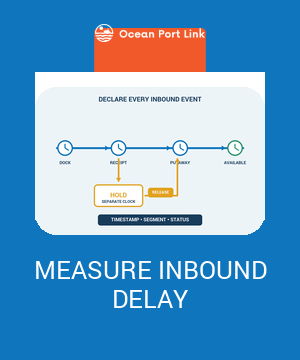
Define dock-to-stock before you time it
Measure dock-to-stock time by subtracting one declared inbound start timestamp from one declared completion timestamp for the same receipt. Keep that calculation at receipt level before aggregating it, and report held, quarantined and still-open receipts separately from ordinary completed flow.
That definition needs to be written down because warehouse systems do not all start and stop the clock at the same event. Oracle describes a report for the time shipments take to move from receiving dock to stock location. Microsoft's warehouse-performance measure runs from item registration until the last put is processed. An importer may also need a later commercial endpoint: the moment the correct quantity becomes available for allocation or sale.
None of those endpoints is automatically wrong. The problem begins when a report calls one of them “dock-to-stock” without saying which one it uses. A fast physical putaway result can coexist with stock that remains blocked, mismatched between systems or unavailable to orders.
This guide gives Australian importers a controlled way to define the clock, locate elapsed time and discuss the evidence with a warehouse or 3PL. It does not set a universal benchmark, staffing level, service promise or safety procedure.
Decide what the measurement must answer
Start with the decision, not a dashboard tile. There are at least two useful questions:
- How long did the warehouse take to register and put away the receipt?
- How long did the importer wait before the received stock became available for its intended use?
The first is a warehouse movement measure. The second crosses inventory-status and system-publication boundaries. They can share events, but they are not interchangeable.
Microsoft's warehouse-performance documentation defines its putaway average from registration until the last put is processed. It also shows breakdowns by vendor and product. Oracle's dock-to-stock report describes movement from receiving dock to stock location and returns a daily average for shipments received and put away in the past seven days. These are product definitions, not a universal industry formula.
An OPL measurement record should preserve the physical-flow result and the availability result when both matter. Do not silently move the endpoint from final put to available-for-sale because the second number looks more commercially useful. Name each clock and retain the event behind it.
Write the metric contract before exporting timestamps
A metric contract is a short record of what the number includes. Freeze it for the reporting period so results remain comparable. If the definition changes, issue a new version rather than rewriting earlier periods.
| Contract field | What to declare | Why it matters |
|---|---|---|
| Facility and cohort | Warehouse, receipt type, date range and included shipment profiles | Prevents unlike operations being blended without disclosure |
| Unit of analysis | Shipment, ASN, purchase-order receipt, pallet or another named receipt object | Keeps the numerator and denominator on the same grain |
| Start event | Exact event name, source system and timestamp field | Separates truck arrival, dock appointment, registration and receipt creation |
| End event | Final put, receipt close, released status or available-in-channel event | Prevents physical storage being mistaken for commercial availability |
| Time basis | Time zone plus calendar or declared operating elapsed time | Makes overnight, weekend and daylight-saving treatment reproducible |
| Partial-receipt rule | First, last or line-level completion and how split receipts are joined | Stops one purchase order becoming several inconsistent observations |
| Hold rule | Which statuses create a separate cohort and which clock continues | Keeps inspection and exception time visible without distorting standard flow |
| Open and cancelled rule | Cutoff age, exclusion reason and completion-rate treatment | Prevents slow unfinished receipts disappearing from the report |
Use the warehouse's identifiers rather than a convenient spreadsheet row number. Retain the shipment, ASN or receipt ID used to join event records. If a single import shipment becomes several warehouse receipts, document that relationship before calculating a duration.
The upstream record should already define expected identity, contents and timing. If it does not, repair that handoff using the 3PL inbound pre-alert and ASN guide; do not make the timing report compensate for an unidentified receipt.
Build an event ladder from owned system records
An average cannot reveal where the time accumulated. Capture adjacent events so each receipt can be split into inspectable segments. Use the system that owns an event and preserve its raw timestamp, time zone, status and actor or source process where available.
| Event | Evidence owner | Segment opened or closed | Control question |
|---|---|---|---|
| Arrival or dock event | Yard, booking or carrier record | Optional arrival-to-registration context | Is this event consistently captured for every included receipt? |
| Item registration | WMS receiving record | Starts the Microsoft-style putaway measure | Does registration cover the same receipt grain used at completion? |
| Receipt/count complete | WMS receiving task | Closes receiving work; opens exception, hold or putaway queue | Were quantity and identity exceptions recorded separately? |
| Hold or inspection status applied | WMS or quality record | Starts the hold interval | Is stock blocked from its intended outbound use? |
| Release status recorded | Authorised quality or inventory-status record | Closes hold; opens release-to-putaway/availability interval | Is the release event distinct from merely moving stock? |
| Putaway work created or started | WMS work record | Separates queue from execution | Was work waiting, or already being processed? |
| Final put confirmed | WMS location/work record | Ends physical putaway clock | Is the entire declared receipt complete under the partial rule? |
| Available state published | WMS, ERP or channel record | Ends commercial-availability clock | Do all relevant systems agree at the declared cutoff? |
Do not infer a missing event from the next event unless that derivation is part of the contract. A final bin balance does not prove when putaway finished. An ERP quantity does not prove when the ecommerce channel received the updated state.
If expected and observed identity, quantity, packaging or condition do not match, open the warehouse receiving discrepancy record. The duration report can show how long the exception remained open; it should not replace the evidence needed to resolve it.
Keep held stock out of the ordinary completion cohort
Physically received stock can remain unavailable. Microsoft's inventory-blocking documentation shows that quantities may be blocked manually, through quality orders or processes, or by inventory status. Its warehouse quality-process documentation also describes movement to a quality-control location and later movement after validation.
Those product behaviours illustrate the state distinction: location and availability answer different questions. They do not establish which goods an importer must inspect or who may release them.
Use separate fields for:
- physical putaway duration;
- hold start and current or release time;
- release-to-available duration; and
- final availability state at the report cutoff.
If a receipt is put away in a quarantine location, its physical clock may be complete while its availability clock remains open. If stock is released before final put, the order reverses. Record the actual event sequence rather than forcing every receipt into a preferred diagram.
The incoming quality inspection guide owns quarantine, inspection and release controls. This article measures their elapsed interval but does not decide whether stock passes.
Calculate receipt-level durations before the summary
For each completed receipt, calculate:
elapsed time = declared end timestamp − declared start timestamp
For an unresolved receipt or segment, calculate age without pretending it is complete:
open-segment age at cutoff = report cutoff timestamp − timestamp that opened the current unresolved segment
Label the cutoff and the open segment. Do not merge that age into completed-duration statistics.
Check that both timestamps use the same time basis and represent the same receipt object. A start recorded per ASN and an end recorded per purchase-order line cannot be subtracted safely until an explicit joining rule aggregates or separates the lines.
Then report more than one summary where the sample supports it:
- completed receipt count;
- total admitted receipt count;
- standard-flow completion share at the cutoff;
- median completed duration;
- average completed duration;
- a named tail measure, such as the longest completed receipt or a percentile when the cohort is sufficiently large; and
- held and open receipt counts with current age.
An average is valid arithmetic, but it can hide a small slow tail. A median describes the middle completed observation but can conceal how much work remains open. A completion share prevents the report from improving merely because incomplete receipts were omitted.
Do not invent a percentile from a handful of receipts. Preserve the observations and sample size. When comparing periods, use the same cohort and definition version or state the change beside the result.
Segment the delay without assigning blame
Subtract adjacent event timestamps to locate where elapsed time accumulated. A useful segment ledger might include arrival-to-registration, registration-to-receipt-close, exception or inspection, putaway queue, putaway execution and put-complete-to-available publication.
| Observed long segment | Evidence to inspect | Safe conclusion | Conclusion not yet supported |
|---|---|---|---|
| Arrival to registration | Appointment, arrival and registration events | Time accumulated before the declared receipt start | Cause, fault or staffing shortfall |
| Registration to receipt close | Scan/count events and discrepancy record | Receiving activity or an exception remained open | Worker performance or supplier fault |
| Hold applied to release | Hold reason, owner, evidence request and release event | Stock remained in a held state for the measured interval | Inspection outcome or legal necessity |
| Putaway work creation to final put | Work creation/start/close and location confirmation | Queue plus putaway execution consumed the interval | Required headcount or safe work method |
| Final put to available publication | WMS, ERP and channel status events | System/status publication lag exists | Which integration is defective without trace evidence |
A long segment is a routing clue, not a verdict. Ask for the records behind the interval and separate queue time from active processing where the event model allows it.
When final put is complete but systems disagree about status or quantity, use the 3PL, WMS, ERP and ecommerce reconciliation guide. Dock-to-stock timing identifies the gap; reconciliation establishes what each system actually held at the cutoff.
Work a small cohort without hiding holds
Consider six fictional import receipts measured over calendar hours. The contract uses WMS registration as the start and final put confirmation as the physical endpoint. Four ordinary receipts are complete, one receipt is on an active quality hold, and one remains open in the putaway queue.
| Receipt | State at cutoff | Completed physical duration | Separate evidence retained |
|---|---|---|---|
| R-101 | Standard complete | 6 hours | All declared events present |
| R-102 | Standard complete | 8 hours | All declared events present |
| R-103 | Standard complete | 10 hours | Receiving exception closed before putaway |
| R-104 | Standard complete | 20 hours | Long putaway-queue segment retained |
| R-105 | Held | Not in standard completed summary | Hold start, reason owner and current age |
| R-106 | Open | Not in completed-duration summary | Last event, open segment and current age |
The four completed standard observations are 6, 8, 10 and 20 hours. Their average is (6 + 8 + 10 + 20) ÷ 4 = 11 hours. Their median is the midpoint of 8 and 10, or 9 hours. Four of six admitted receipts are standard complete at the cutoff, a descriptive share of 4 ÷ 6 = 66.7%.
None of those figures is a service target. The example shows why the summary needs its cohort note. Reporting only 11 hours would hide the active hold and open receipt. Folding their current ages into a completed average would invent endpoints they have not reached.
Compare like inbound work with like
Segmentation should begin with operational differences likely to change the event path. Useful cohort fields include facility, planned versus unplanned receipt, pallet versus case handling profile, new versus established SKU, relabelling or rework requirement, full versus partial receipt and whether an approved pre-alert matched the load.
Do not split data until every small group appears favourable. Choose cohort fields before viewing the result and keep enough observations to make the comparison interpretable. A one-off project receipt should not silently reset the standard replenishment baseline, but it should remain visible in total inbound reporting.
Keep supplier/carrier transit performance outside the warehouse clock unless the metric contract explicitly includes an arrival segment. The warehouse cannot put away stock before it is present, while the importer still needs a separate end-to-end view of the broader replenishment timeline.
Use the record in a warehouse or 3PL review
Ask for event-level data rather than a presentation average. The review pack should show the metric-contract version, admitted receipt list, raw start/end events, completed/open/held status, duration, segments and evidence links for material outliers.
Compare the warehouse's existing report definition with the importer's decision. If the 3PL stops at final put and the importer needs channel availability, retain the 3PL measure and add the later system event. Do not accuse the provider of missing a metric it never agreed to supply.
Avoid importing a benchmark from a vendor article into a service review. Product mix, arrival pattern, facility flow, inspection requirements, data interfaces and receipt grain can all change the result. Establish the current baseline under a stable definition, then investigate repeatable segment changes. Any contractual conclusion about an SLA belongs to the accepted agreement and authorised review, not this operational guide.
Build a repeatable inbound control
At each review cutoff:
- Freeze the metric-contract version and admitted receipt list.
- Validate a sample of start, end and hold events against their source records.
- Calculate receipt-level durations before summary measures.
- Publish completed, held and open counts separately.
- Compare declared cohorts and inspect the segments behind outliers.
- Record definition, system or workflow changes before the next period.
The goal is not the smallest possible number. It is a measurement that tells an importer whether time accumulated before receipt, during an exception or hold, in the putaway queue, in physical completion or while status moved between systems. Once that location is evidenced, the responsible process owner can decide what investigation comes next.
Sources
- Oracle Warehouse Management: Dock to Stock Per Day, reviewed 17 September 2026; current 26B product-specific dock-to-stock report scope, seven-day inclusion window and daily average.
- Microsoft Learn: Warehouse performance Power BI content, updated 8 April 2026 and reviewed 17 September 2026; registration-to-last-put definition and inbound breakdowns.
- Microsoft Learn: Inventory blocking, reviewed 17 September 2026; blocked inventory states and quality-process context.
- Microsoft Learn: Quality management for warehouse processes, reviewed 17 September 2026; quality-control location and post-validation movement workflow.
- Reddit: KPI discussion and system says in stock but operations say it is not, reviewed 17 September 2026; unverified audience questions and language only, not factual or operational authority.


