

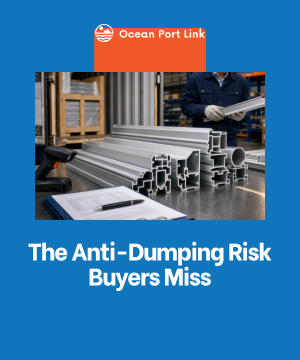

Yes—aluminium extrusions imported from China can attract Australian anti-dumping and countervailing duties, and the outcome may depend on far more than the HS code. The exact profile, legal manufacturer, exporter, invoice chain and export price can all affect the assessment.
This matters because aluminium extrusions are often hidden inside finished or semi-finished products: solar rails, LED channels, window systems, shower-screen frames, racking, machinery and furniture. A buyer may think they are importing a finished kit while Australian customs treatment still turns on the extruded component.
Why this duty risk is easy to miss
Many importers ask a supplier for an HS code and assume the answer settles the duty question. It does not. Tariff classification is relevant, but anti-dumping scope is determined by the goods description and the current Australian measures.
The published aluminium extrusion scope covers specified aluminium alloys and products made through an extrusion process. Technical factors can include alloy, temper, finish, cross-section, wall thickness, diameter, weight per metre and whether the goods fall within an exclusion.
The safest approach is to assess the exact drawing and transaction before paying for tooling or mass production.
What counts as an aluminium extrusion?
Under Australia’s current measures, the covered goods broadly include aluminium products produced by extrusion, whether finished or unfinished, within defined technical limits. The current notices should be checked for the precise description, tariff classifications and exclusions.
For each profile, collect:
- A dimensioned technical drawing.
- Alloy and temper.
- Surface finish, coating or anodising details.
- Wall thickness and external dimensions.
- Cross-sectional shape.
- Weight per metre.
- Intended use and whether the profile is imported alone or within a kit.
A customs broker cannot give a reliable assessment from a supplier photograph or generic product name.
The exporter can change the duty outcome
Australian anti-dumping treatment is not always one fixed percentage for every Chinese supplier. Individual exporters can have exporter-specific rates or duty methods. Other exporters may fall under residual or uncooperative treatment.
In July 2026, the Anti-Dumping Commission finalised accelerated review 701 for aluminium extrusions exported by Guangdong Guangyuan Aluminum Co., Ltd. The final notice applied a confidential floor-price method for interim dumping duty and an effective interim countervailing duty rate of 0.2% for that exporter.
Under a floor-price method, dumping duty becomes payable when the actual export price is below the confidential floor price. Because the benchmark is confidential, buyers cannot calculate the result using a public percentage alone.
The official record is available through the Anti-Dumping Commission case 701 page.
The manufacturer and exporter may be different companies
A factory may manufacture the profiles while a trading company exports them. A DDP provider may also arrange export documents through a separate entity. That distinction is commercially important.
An importer may receive a landed-cost estimate based on one exporter’s treatment, only for the final invoice or declaration to identify another company. The duty method can then be different from the one originally assessed.
Documents to obtain before paying a deposit
- The legal Chinese and English name of the manufacturer.
- The legal name and address of the exporter.
- The commercial-invoice entity.
- A written explanation of any trading-company relationship.
- Confirmation of who will appear on the export declaration.
- Technical drawings and material specifications for every profile.
Supplier verification should happen before landed-cost modelling. OPL’s guide to verifying Chinese suppliers explains how to check legal names, documents and factory claims.
Products that can contain covered extrusions
The risk is not limited to raw aluminium lengths. Extruded components can appear in:
- Window and door systems.
- Solar mounting rails and clamps.
- LED lighting channels.
- Shower-screen and wardrobe frames.
- Industrial machine frames.
- Racking and shelving systems.
- Display and signage structures.
- Furniture and architectural kits.
Whether a finished assembly remains within scope is a technical and legal question. Do not rely on a supplier’s statement that the product is “finished” or “not raw aluminium”.
Why DDP does not remove the importer’s exposure
DDP can simplify commercial payment, but it does not make an incorrect declaration harmless. A supplier or forwarder may use the wrong exporter, overlook the measure, understate value or classify the goods incorrectly.
Possible consequences include unexpected duty and GST, customs securities, clearance delays, reassessment and a dispute over who absorbs the extra cost. The Australian buyer should understand who acts as importer of record and how the goods will be declared.
Importer discussions about low-cost DDP commonly focus on whether duty, GST and declarations are being handled correctly. Those discussions are anecdotal, but they highlight the right due-diligence question: a low delivered price is not evidence of compliant customs treatment.
A practical pre-order workflow
- Obtain drawings and complete material specifications.
- Identify the legal manufacturer and exporter.
- Check the current Dumping Commodity Register and case records.
- Give the complete product and transaction details to a licensed Australian customs broker.
- Request a written landed-cost assessment before production.
- Confirm the invoice and exporter structure before final payment.
- Check the shipping documents against the structure that was assessed.
Frequently asked questions
Is the HS code enough to determine anti-dumping duty?
No. The HS code is one input. The goods description, technical scope, exporter, manufacturer and transaction details can all matter.
Is there one anti-dumping rate for every Chinese aluminium supplier?
No. Exporter-specific rates and duty methods may apply. A trading company and the underlying manufacturer may also be treated differently.
Does importing a finished product avoid the measure?
Not automatically. Finished and semi-finished products containing extruded components may still require a scope assessment.
Can a supplier guarantee that no duty applies?
A supplier can provide documents and past shipping experience, but the shipment-specific assessment should be confirmed with a licensed Australian customs broker.
The careful importer checks the transaction, not just the product
The biggest mistake is treating anti-dumping duty as a generic country percentage. For aluminium extrusions, the exact product, exporter, manufacturer, invoice chain and price can determine the outcome.
Ocean Port Link can collect supplier identities, drawings, specifications and commercial documents for a proper broker review, then coordinate sourcing, quality control and logistics around the confirmed structure. Contact OPL before committing to an aluminium order.
This article provides general commercial information and is not customs or legal advice. Confirm treatment for the specific shipment with a licensed Australian customs broker.
Related China sourcing guides


.png)