

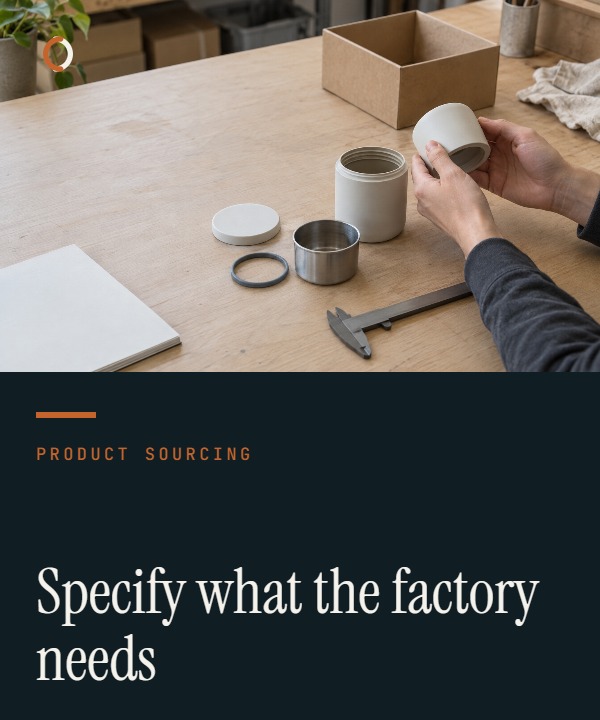
A product specification sheet should let a factory answer four questions before it quotes: What exactly are we making? Which requirements are non-negotiable? How will conformity be checked? What must happen if the factory cannot meet a requirement?
If the document cannot answer those questions, it is still a product description—not a manufacturing specification.
That distinction becomes expensive after a deposit is paid. A supplier may interpret “stainless steel”, “premium finish” or “strong carton” reasonably yet differently from the buyer. A sample may look acceptable while using a construction that is difficult to repeat. A factory may discover a design-for-manufacture problem and quietly alter a detail instead of asking for approval.
This guide provides a field-by-field specification framework for Australian businesses sourcing from China. It is designed to sit inside or alongside a controlled request for quotation, then follow the product into sampling, production, testing and inspection.
If the commercial request itself is not ready, start with OPL’s guide to writing an RFQ Chinese suppliers can quote properly. The RFQ asks for a commercial offer. The specification defines the product on which that offer is based.
A specification is the product’s controlled source of truth
A useful specification records the requirements that determine whether a product is acceptable. That may include materials, dimensions, tolerances, colour, construction, performance, warnings, packaging and test methods. The exact fields depend on the product.
The document does not need to contain every technical artefact. CAD files, artwork, bills of materials, test protocols and packaging drawings may remain separate attachments. The specification should identify those files by exact name and revision so there is one controlled package.
Nor does a specification guarantee that production will conform. It reduces ambiguity, creates a basis for supplier acknowledgement and gives sampling and inspection something objective to check. The American Society for Quality defines inspection as measuring, examining, testing or gauging characteristics and comparing the results with specified requirements. If the requirement is not specified, an inspector cannot reliably decide whether the result conforms.
Do not confuse the specification with these other controls
- RFQ: requests prices and commercial terms against a defined product.
- Technical drawing: controls geometry, dimensions, tolerances and technical notes that are better expressed graphically.
- Approved sample: provides a physical reference, particularly for appearance, feel and assembly—but cannot reveal every hidden material or process requirement.
- Purchase order: records the commercial order and must identify the applicable specification revision.
- Inspection checklist: converts selected requirements into checks, sample sizes, methods and acceptance decisions.
- Manufacturing agreement: may address legal and commercial obligations that a technical specification cannot safely replace.
Treat these documents as a connected control system. Do not expect one file to perform every job.
Start with document control, not product prose
The first block should tell everyone which document governs the order. Include:
- product name, model and SKU;
- specification number and revision;
- issue date and document owner;
- status such as draft, issued for quotation or approved for production;
- applicable variants, colours and sizes;
- linked drawing, artwork, bill-of-materials and packaging-file revisions;
- the purchase orders or production lots to which the revision applies; and
- buyer and supplier approval fields.
These are not administrative decorations. They prevent an old artwork file, superseded material proposal or prototype drawing from becoming the production basis.
Current ISO management-system guidance is useful here even when a small importer is not operating an ISO-certified system. It says controlled documented information should have appropriate identification, format, review and approval, and should be subject to change or version control. Those are sound operating principles, not a claim that adding a revision number makes the document “ISO compliant”.
The field-by-field product specification framework
Use one row per requirement or tightly related group of requirements. Give each critical requirement an identifier so it can be referenced in the supplier response, sample review and inspection report.
| Specification field | What the buyer defines | What the supplier returns | Acceptance evidence |
|---|---|---|---|
| Product identity and variants | Model, SKU, intended use, user, size, colour and market variants | Exact item and variants proposed | Approved product list and linked files |
| Materials and components | Grade, composition, thickness, hardness, brand or approved-equivalent rule | Exact material, component maker and any proposed substitute | Datasheet, certificate, bill of materials or test result where appropriate |
| Dimensions and tolerances | Nominal dimension, unit, permissible range and critical designation | Achievable tolerance and manufacturing constraint | Drawing, calibrated measurement and inspection record |
| Colour and appearance | Controlled colour reference, gloss, texture, finish, workmanship limits and viewing conditions | Matching process and known variation | Approved reference, boundary sample or agreed visual criteria |
| Construction and process | Assembly, joining, treatment, coating, print, curing or other process requirement where outcome depends on it | Proposed process and any subcontracted step | Process record, sample, drawing or production control |
| Function and performance | Load, fit, cycle life, capacity, leakage, operating environment or other measurable result | Test method, equipment, sample quantity and expected result | Test report or witnessed result |
| Australian compliance | Applicable mandatory requirement, warning, label, registration or evidence identified by the importer or adviser | Existing evidence, exact model covered, laboratory, report date and gaps | Verified report, registration or qualified assessment as applicable |
| Artwork and marking | Artwork revision, dimensions, placement, colour, print method, batch or model marking | Proof and production method | Approved artwork proof and first-off sample |
| Retail and export packaging | Pack-out, material, protection, dimensions, barcode, labels, inserts, carton limits and pallet rule | Proposed construction, MOQ, carton dimensions and weights | Packaging drawing, drop/compression check where justified, barcode verification where required |
| Quality-critical features | Characteristics most likely to affect safety, function, fit, compliance or customer acceptance | Control method, frequency and escalation route | Control plan, inspection checklist and defect catalogue |
| Change control | No unapproved change to identified materials, components, process, tooling, factory, artwork or packaging | Notification owner and change-request process | Approved change record and updated revision |
| Supplier exceptions | Instruction that every non-conforming or assumed point must be listed | Comply, exception or clarification for each requirement | Signed response matrix and numbered deviation list |
Not every row needs a certificate. Evidence should be proportionate to the risk and the claim. A critical electrical component, food-contact material or load-bearing feature needs a different level of control from the shade of an internal transit insert.
Separate requirements, targets and preferences
A common mistake is making everything sound mandatory. That can force unnecessary cost into the quote, discourage useful manufacturing feedback and leave the factory unable to see which characteristics matter most.
Classify each line:
- Requirement: must be met for the product to be accepted.
- Target: desired result, with a defined process for evaluating a supplier’s alternative.
- Preference: useful but not worth rejecting the product or redesigning the process.
- Supplier proposal: deliberately open; the supplier must recommend and document a solution.
- To be confirmed: unresolved and not authorised for silent assumption.
Also identify critical-to-quality characteristics. These are the small number of features where failure has a disproportionate effect on safety, compliance, fit, function or customer acceptance. Give those characteristics clearer tolerances, evidence and escalation rules.
Decision rule: If a requirement has no defined acceptance method, it remains open to interpretation—however precise the wording appears.
Specify tolerances and measurement methods together
“Length: 300 mm” is incomplete when manufacturing variation matters. Does 299.5 mm pass? What about 301 mm? Which instrument is suitable, and where is the measurement taken?
For each controlled dimension or performance characteristic, state:
- the nominal value and unit;
- the permitted range or tolerance;
- whether the tolerance is bilateral, unilateral or defined by a limit;
- the measurement location and orientation;
- the test or measurement method;
- required equipment and resolution where material;
- conditioning or environmental requirements; and
- the sampling or inspection stage.
Do not invent tight tolerances because they look professional. Ask what the product function actually requires, then confirm manufacturability and measurement capability. An unnecessarily tight tolerance can add tooling, scrap, inspection and delay without improving the user outcome.
Where specialist engineering is needed, obtain it. A sourcing agency or factory can flag practical questions, but should not be used as a substitute for a competent product engineer, laboratory or compliance adviser.
Put Australian requirements into the product definition early
Compliance is not an attachment requested after the product has been designed. It can determine materials, construction, performance, warnings, labels, packaging and test methods.
For the broader importer responsibilities surrounding customs, biosecurity and product rules, see OPL’s Australian import regulations guide. This section stays focused on translating confirmed product requirements into the factory specification.
ACCC Product Safety explains that mandatory standards apply only to particular products, but where one applies its requirements may concern performance, composition, contents, manufacture, design, construction, finish, packaging or labelling. Importers are included among the suppliers responsible for complying.
Before freezing a specification:
- identify the exact product, user, intended use and foreseeable misuse;
- check current Australian mandatory standards and bans;
- identify any sector regulator, registration or marking regime;
- determine which product variants and components the evidence must cover;
- name the applicable test method or requirement accurately;
- specify warnings, instructions, labels and language where required; and
- record who is responsible for obtaining and verifying evidence.
Electrical equipment illustrates why model identity and change control matter. The EESS guidance for responsible suppliers says the importer may need to show that imported equipment is the same in design, construction and components as the equipment used for certification. A report for a similar-looking model is not automatically evidence for the item being ordered.
Packaging can also carry channel-specific requirements. GS1 Australia’s retailer guidance shows that consumer units, cartons and pallets can require different identifiers, while individual retailers may impose their own current rules. Record the intended sales channel before artwork approval, not after cartons have been printed.
This article cannot determine which rules apply to a particular product. Use the relevant regulator and qualified advice where classification, testing or legal interpretation remains uncertain.
Require a supplier exception and DFM review
A capable factory should be allowed to challenge an impractical requirement. It should not be allowed to change one silently.
That process assumes the supplier has already passed an appropriate identity and capability review. If it has not, use OPL’s guide to finding and verifying reliable suppliers on Alibaba and beyond before treating a technical response as evidence of manufacturing capability.
This distinction appears repeatedly in manufacturing discussions. One founder on Reddit described receiving a prototype whose details had been changed because they were “difficult to achieve”. The concern was not simply that the design needed adjustment; it was that the change arrived without prior disclosure. A similar r/manufacturing discussion captured the buyer’s concern precisely:
“What surprised me wasn't the changes themselves. It was that nobody mentioned them before sending the sample.” — r/manufacturing discussion, June 2026
These are anecdotes, not evidence that every supplier behaves this way. They do identify a process gap worth closing.
Send an exception matrix with the specification. Require the supplier to return, for every relevant line:
comply;exceptionwith the proposed alternative and reason; orclarification requiredwith a specific question.
For each exception, request the effect on price, lead time, tooling, performance, testing and appearance. Resolve the issue before approving the sample or production revision. A “yes, no problem” message is not a technical review.
Control revisions and substitutions after approval
The specification should state that identified materials, components, construction, processes, tooling, subcontracted sites, artwork and packaging cannot be changed without written approval.
Use a simple change record:
| Change-control field | Required entry | Purpose |
|---|---|---|
| Change request | Unique number, date and requester | Makes the proposal traceable |
| Affected requirement | Specification, drawing, component and current revision | Locates the exact baseline |
| Proposed change and reason | Old state, new state and cause | Prevents vague “equivalent” substitutions |
| Impact review | Quality, compliance, testing, tooling, cost, timing and inventory | Exposes downstream consequences |
| Evidence required | New sample, drawing, datasheet, test or inspection | Defines what must be checked |
| Decision | Approved, rejected or conditional, with approver and date | Creates an auditable outcome |
| Effective point | Purchase order, lot, serial/batch or date | Stops old and new versions being mixed |
The ACCC’s sourcing and testing guidance specifically warns that design, material or production changes can make retesting necessary. That does not mean every change requires a full laboratory programme. It means the impact must be assessed before the change is accepted.
Worked example: a shelf-bracket specification extract
The following example is illustrative. It is not an engineering drawing, load certification or product-specific compliance decision.
| Requirement ID | Controlled requirement | Acceptance method |
|---|---|---|
| ID-01 | Model SB-02, matched left/right bracket pair |
Product and carton labels match SKU and approved drawing revision |
| MAT-01 | Steel grade and minimum sheet thickness stated in the approved material line | Supplier material certificate plus thickness measurement at defined points |
| DIM-01 | Hole centres and mounting-face geometry to drawing SB-02-DWG-R04 |
Caliper, gauge or fixture method nominated in inspection checklist |
| FIN-01 | Powder-coat colour to controlled reference; defined gloss target and visible-surface limits | Approved boundary sample under agreed viewing conditions |
| FUN-01 | Load-test arrangement, load, duration, mounting substrate and permissible deformation defined by competent designer | Recorded test on specified sample quantity |
| PKG-01 | Pair protected from abrasion; fixings separated; units per carton and maximum gross weight defined | Approved pack-out sample and carton measurement |
| CHG-01 | No material, thickness, hole-pattern, coating-system or production-site change without approved request | Current change register and purchase-order revision |
Notice what is absent: “heavy duty”, “high quality” and “standard export packaging”. Those phrases communicate an intention but do not establish an acceptance decision.
Turn the approved specification into production controls
Once the specification is approved, do not leave it sitting in the RFQ folder.
Use it to create:
- a sample-review record that checks every critical requirement;
- a golden or approved sample with an unambiguous revision and approval purpose;
- a product-specific inspection checklist;
- defect examples and severity classifications;
- test instructions and evidence requirements;
- packaging and carton checks;
- purchase-order references; and
- a controlled change log.
The inspection checklist should cite requirement IDs rather than rewrite them from memory. That keeps the buyer, factory and inspector on the same revision and makes contradictory instructions easier to find.
The specification also needs supplier ownership. Ask the factory’s technical contact—not only the salesperson—to acknowledge the document, return exceptions and confirm that the production and quality teams can access the final revision.
Final specification-sheet checklist
Before issuing the document for quotation or production, confirm that:
- the product, SKU, variant and intended use are unambiguous;
- the specification, drawings, artwork and packaging files have matching revision control;
- every critical material and component is named precisely enough to prevent silent substitution;
- dimensions include units, justified tolerances and measurement methods;
- appearance requirements use controlled references and realistic viewing criteria;
- function and performance requirements state how they will be tested;
- applicable Australian requirements have been researched for the exact product and market;
- testing evidence is linked to the correct model, design and components;
- retail and export packaging are defined separately;
- critical-to-quality characteristics are clearly prioritised;
- the supplier must return every exception before approval;
- design-for-manufacture proposals follow a written review process;
- changes after approval require an impact assessment and new authorisation; and
- the approved revision feeds the sample, purchase order, quality plan and inspection checklist.
A good specification creates better questions
The strongest specification sheet is not necessarily the longest. It is the one that causes useful disagreements before production.
A factory may explain that a tolerance is unrealistic, a finish needs another process, a preferred component has an excessive minimum order or a load test requires a different construction. Those responses are valuable when they arrive as declared exceptions with evidence and commercial effects.
What matters is that the buyer—not an undocumented assumption—decides what changes.
Build one controlled product definition, invite the factory to challenge it, close every material exception in writing and carry the approved revision into sampling and inspection. That is how a product idea becomes something a supplier can quote and manufacture—and something an Australian importer can meaningfully verify.
Sources
- ACCC: Product safety responsibilities
- ACCC Product Safety: Product safety standards and how to comply
- ACCC Product Safety: How to source and test products
- ISO: Harmonized structure for management system standards with guidance
- ASQ: Quality glossary
- Electrical Equipment Safety System: FAQ
- GS1 Australia: Retailer requirements for packaging and barcodes
- GS1 Australia: Creating and printing barcodes
- Reddit r/Entrepreneur: prototype changed without notification
- Reddit r/manufacturing: practical prototype adjustments versus unauthorised changes
Reddit discussions are included as anecdotal audience research, not representative evidence of supplier behaviour.


