

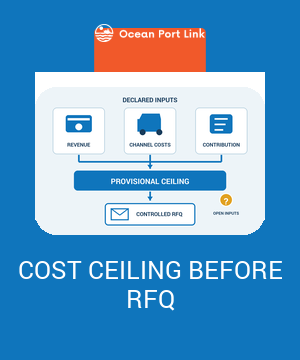
Before requesting supplier quotations, work backwards from a supported selling-price assumption to a provisional landed-cost ceiling. On one clearly defined unit and tax basis, subtract the other sale-dependent costs and the contribution amount you want to retain from planned net revenue. The remainder is the most that the bounded scenario leaves for inbound landed cost. It is an internal screening constraint, rather than evidence of what a factory should charge.
The useful work happens around that subtraction. Record where each input came from, who owns it, what remains uncertain and which product, quantity and delivery endpoint the ceiling assumes. Freeze that record before the enquiry. Otherwise, an attractive quote can prompt unnoticed changes to price, fees or product requirements until almost any order appears acceptable.
The framework below is OPL analysis for an Australian importer preparing an RFQ, or request for quotation. Its numerical example is hypothetical and deliberately limited to one retained sale of one saleable inbound unit. It does not validate an importer's selling price, tax treatment, financial target or decision to spend. A missing material input leaves the real ceiling unresolved.
Decide what the ceiling is allowed to tell you
A target landed-cost ceiling answers a narrow question: under the assumptions recorded here, how much room remains for acquiring this unit at the chosen receiving endpoint? It prepares procurement to ask useful questions before quotations arrive. It cannot establish customer demand, adequate working capital, product compliance or supplier capability.
Start with the decision owner. A product buyer may prepare the sourcing brief while an ecommerce lead supplies channel assumptions and a finance owner supplies the contribution requirement. Name those roles in the record.
The idea of working backwards from customer value has a recognised manufacturing counterpart in Lean Enterprise Institute's description of target cost. Here, however, the object is an importer's sourcing constraint. It does not reveal a supplier's production cost, acceptable profit or fair quotation price.
Keep the ceiling separate from order approval. A quote fitting the scenario still needs supplier, specification, quality, compliance, freight and commercial checks. Clearing an RFQ preparation gate authorises the next enquiry step within your process; it does not automatically authorise a deposit or purchase order.
Lock the product, channel and calculation unit
Use one product specification and revision, one sales channel and one defined customer geography. State the assumed enquiry quantity and the endpoint for inbound cost, such as delivery to a specified receiving warehouse. Include currency and the version date. These details identify what the calculation actually describes.
Channel changes can matter as much as a supplier discount. A direct online sale and a wholesale sale may have different revenue, payment, delivery and servicing assumptions. Preserve separate scenarios rather than averaging them into a single cost ceiling that belongs to neither channel.
The calculation unit needs equal care. A customer order containing two products is not the same unit as one saleable imported product. A fixed charge per order cannot be copied into a per-product calculation without a stated allocation assumption. If that allocation is unsettled, flag it for resolution rather than choosing the version that produces more headroom.
For the simple example used here, the unit is one retained sale of one saleable inbound unit. There is no additional purchased-unit loss, returned-unit loss or unsold-stock acquisition cost in the example. That simplification is visible because introducing those effects can change the relationship between landed cost and the outcome. It is not permission to omit them from a real sourcing decision.
Admit selling-price evidence before entering a number
A desired retail price is not evidence that customers will pay it. business.gov.au's pricing guidance recommends market research and testing price options, alongside considering business goals and costs. Use that distinction when building the sourcing brief: record a price hypothesis and its supporting observations separately.
Compare products with similar features, quality, customer proposition and sales conditions. Record whether an observed competitor price was a temporary promotion, bundle or price excluding delivery. Those observations may help frame a hypothesis, but they do not prove your own achievable revenue or sales volume.
Where customer testing exists, retain the test date, offer, channel and result. Where it does not, mark the price provisional. Procurement can still collect quotations to improve information, but the internal record must show that the demand and revenue assumptions have not been validated.
The revenue input should reflect the planned net realised revenue on the declared basis, rather than a remembered ticket price. If discounts, refunds or delivery receipts matter, have their treatment resolved before calling the input ready. Do not invent a percentage deduction because a calculator requires one. Shopify's pricing guidance similarly connects costs, market and value proposition; its examples do not validate an Australian importer's particular price.
Build an input register that exposes uncertainty
The register is the main control. Store a value or range beside its source, owner, date, calculation basis and status. Use plain statuses such as confirmed for this scenario, provisional, and unresolved. Confirmation means the named owner has accepted that scenario input; it is not proof of future commercial performance.
| Input group | Evidence to retain | Question before using it |
|---|---|---|
| Planned net revenue | Price-test or market-evidence record and revenue assumptions | Does it match this product, channel, geography and unit? |
| Other sale-dependent costs | Relevant fee terms, delivery/service quotes and approved allocations | Is each cost on the same basis and counted once? |
| Contribution allowance | Named owner's declared amount or revenue-based percentage | What does the retained amount cover, and what remains outside? |
| Inbound scope | Product revision, enquiry quantity and receiving endpoint | Which charges will the later landed estimate need to include? |
| Unresolved exposures | Question, evidence owner and next review date | Could this change the formula or invalidate the ceiling? |
An input with a precise number can still be provisional. A published fee schedule might require account-specific conditions; a service quote might exclude a customer zone. Preserve the applicable terms instead of stripping the number from its qualifications.
Keep a percentage fee's actual charging base, applicable fixed component and conversion to AUD per unit. A rate is not a currency amount; do not assume the provider charges against your defined net revenue.
Tax basis is a required input decision, not a generic switch marked registered or unregistered. Ask the accountant or appropriate competent adviser to confirm the treatment of sales and costs for this scenario. The method here does not determine credit entitlement, customs treatment or accounting classification. Until that basis is settled, do not present the resulting ceiling as ready for a real commercial decision.
Separate inbound landed cost from channel costs
Draw the boundary at the specified receiving endpoint. The OPL landed-cost guide owns the bottom-up inbound cost model. Bring that scope into the preparation record without rebuilding duty, GST, customs or freight instructions in the ceiling worksheet.
Other sale-dependent costs sit outside that inbound boundary. Depending on the approved scenario, these might include outbound fulfilment, seller-funded customer delivery, payment or marketplace charges and directly attributable selling activity. Their inclusion, allocation and tax treatment must be explicit. The same warehouse service cannot appear in both the inbound landed estimate and the channel allowance.
Audience questions show why the boundary deserves attention. In an Australian furniture ecommerce discussion on Reddit, a prospective operator describes customer-delivery costs leaving little room after acquisition. This is an unverified anecdote, not a freight benchmark. Its useful question is whether the model has reserved anything for the sale after the product reaches Australia.
For actual-period fee credits, refunds and returned-stock outcomes, use the OPL contribution-margin guide. The pre-RFQ record is a planning hypothesis. It must not disguise provisional allowances as the closed transaction evidence that guide requires.
Calculate only within the declared additive scenario
For the limited scenario, define three owner-supplied inputs on the same unit, currency and approved basis:
R: planned net realised revenue per unit.V: other sale-dependent costs per unit, excluding everything in inbound landed cost.T: the contribution amount the importer chooses to retain per unit.
The allowable landed cost is L = R − V − T. This is elementary subtraction under the stated definitions. It does not select an appropriate financial target. Contribution is the amount left within the defined model, rather than net profit or proof that fixed overhead, financing and cash requirements are covered.
If the owner states the target as a fraction m of the defined revenue, then T = m × R. Label that denominator. A revenue-based percentage is different from markup on cost, and a gross-margin target cannot silently replace a contribution requirement after other costs have been deducted.
Any reserve also needs an owner and boundary. Show where it appears and count it once. A selected reserve is an assumption, not a known charge, industry norm or statistical confidence level. Do not add an arbitrary safety percentage and describe the ceiling as protected against uncertainty.
Show the scenario change before changing the ceiling
Consider a hypothetical unit with AUD 100 planned net revenue, AUD 25 other sale-dependent costs and an owner-selected AUD 30 contribution allowance. All figures use the same declared basis. The additive ceiling is 100 − 25 − 30 = AUD 45.
Now change only the other sale-dependent cost assumption to AUD 32. The revenue and retained contribution remain unchanged. The ceiling becomes 100 − 32 − 30 = AUD 38. Nothing about supplier performance or factory efficiency was established by that change; the importer simply has less room under the revised channel assumptions.
| Hypothetical input | Baseline | Changed cost scenario |
|---|---|---|
| Planned net revenue per unit | AUD 100 | AUD 100 |
| Other sale-dependent costs | AUD 25 | AUD 32 |
| Selected contribution allowance | AUD 30 | AUD 30 |
| Allowable inbound landed cost | AUD 45 | AUD 38 |
The example contains invented arithmetic values, not a customer case, typical margin or recommendation. Keep it labelled that way. A downside scenario is another set of declared assumptions; it is not a forecast with an assigned probability or a promise that the business will withstand disruption.
A zero or negative remainder signals that this particular set of inputs leaves no positive inbound-cost room. Revisit evidence and scope with the responsible owners. It does not establish that the business is insolvent, the product is unlawful or a higher customer price will work.
Stop when losses or fee dependencies change the model
The additive example has a narrow boundary. Material returns, damaged or rejected purchased units, unsold inventory, multiple products per order and conditional fee structures can make a real model more complicated. A cost linked to landed value cannot always be treated as an independent fixed allowance.
For example, adding an expected lost-unit cost may require deciding how many purchased units support the retained sales and which acquisition costs remain attached to them. Copying a loss percentage from a forum into a flat cost row does not resolve that denominator. It can also count product cost twice if another allowance already includes the same loss.
Record the unresolved dependency and obtain a reviewed model from an appropriately competent person before treating the ceiling as approved. This article deliberately provides no return/yield calculator or accounting allocation prescription. The inability to complete a real ceiling should remain visible; it is more informative than a precise result produced by omitted costs.
Reddit discussions also contain broad claims about the margin an Australian ecommerce business should target, including this startup discussion. Those are unverified contributor opinions. They may suggest questions to ask the finance owner, but they are not evidence for your contribution requirement or a universal viability threshold.
Turn the internal ceiling into a controlled supplier enquiry
Keep the landed ceiling distinct from the goods-price quote. The supplier's price may cover a different endpoint or service scope. A residual calculated by subtracting an unsupported freight or duty estimate cannot safely be labelled a maximum FOB or EXW price. Current quotations, allocation and competent customs/tax input are needed to build the later landed estimate.
Prepare a handoff containing the product revision, quantity, receiving endpoint, internal scenario version and the questions whose answers will improve the estimate. Ask for explicit supplier scope and exclusions using the OPL RFQ guide. The buyer can choose a disclosure approach; the method imposes no universal rule to reveal or conceal the internal ceiling.
In the hypothetical example, baseline version 1 retains AUD 45; version 2 records the changed channel-cost assumption and AUD 38. Keep both, identify the input owner and attach the reason before revising the enquiry record.
An above-ceiling quote is information. It may expose an unsupported selling-price assumption, incompatible scope or an enquiry quantity with different economics. It is not proof of overcharging. If supplier cost drivers need investigation, the should-cost guide addresses that different task.
When quotes arrive, use the supplier-quote comparison guide to normalise their scope and prepare the landed estimate. Preserve both the quote version and the internal baseline. A quote that appears to fit only after dropping product, testing or quality requirements has not satisfied the original enquiry.
Preserve a decision record that can be challenged
Before sending the enquiry, save the baseline and identify the unresolved questions that remain open. Give each question an evidence owner and review date. Procurement should be able to distinguish collecting prices under provisional assumptions from approving an order under confirmed ones.
When an input changes, retain the earlier value, source and version alongside the reason and approval for the revision. Show its effect on the ceiling. Do not overwrite the baseline until it looks as though the first quote met it all along. A changed selling-price hypothesis requires renewed evidence, rather than an automatic upward adjustment to absorb acquisition cost.
Start the sourcing discussion with that record: which inputs are ready, which need evidence, and what the supplier enquiry must resolve. Preserve the open questions when collecting prices.
Sources
- business.gov.au: Choose a pricing strategy, retrieved 16 September 2026; market research, price testing and pricing-goal context.
- Lean Enterprise Institute: Target Cost, retrieved 16 September 2026; conceptual manufacturing target-cost background.
- Shopify Help Center: Pricing your products, retrieved 16 September 2026; general costs, market and value-proposition context.
- Reddit: Furniture ecommerce business feels impossible and Australian ecommerce startup discussion, retrieved 16 September 2026; unverified audience anecdotes/opinions only, not factual or financial authority.


.png)
