

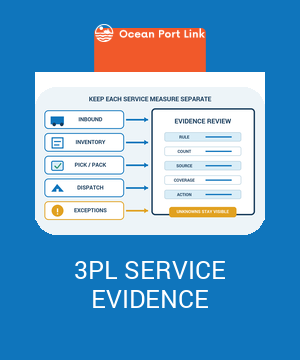
A useful 3PL fulfilment scorecard starts with your agreed service definition and source records, not an industry target. Define which inbound jobs and ecommerce orders were eligible, when each clock started and stopped, which event proves the result, what remains unknown and who supplied the data. Then show separate measures for inbound completion, inventory counts, order completeness, fulfilment-error classification, dispatch timing and exception handling.
The framework below is OPL operational analysis for reviewing your own 3PL service. It does not establish a universal benchmark, rank providers, interpret a contract or determine a commercial remedy. Its purpose is narrower: turn source records into a reproducible review pack that identifies an observed outcome or evidence gap needing a specific operational action.
Define the measured service before choosing a metric
Start with the service your importer assigned to the 3PL. Record the contracting entity only as an identifier; the scorecard still needs the warehouse site, sales channel, order type and service path that produced the observation. Separate direct-to-consumer parcels, wholesale cartons, marketplace orders, kits and special projects when their work or clocks differ.
Write the responsibility boundary beside each measure. A warehouse can usually evidence when an eligible order entered its system, when work was completed and when a parcel received a carrier-acceptance event. Customer delivery depends on the carrier service after dispatch. Do not label delivery performance as warehouse dispatch performance unless your adopted service definition and source fields genuinely measure the same obligation.
Record the timezone, working calendar, cut-off and exception rules already used for that service. This article does not supply a default same-day cut-off, response time or acceptable error rate. If the service definition is incomplete, the first review action is to fix the definition prospectively rather than invent it after seeing the result.
Build an eligible due cohort before extracting outcomes
An eligible order is one the warehouse could act on under the adopted service rules. Define the release-ready event: for example, payment and fraud checks complete, required inventory allocated, address data accepted and no importer hold. Record when the 3PL received or acknowledged that state. An order placed before a storefront cut-off is not necessarily warehouse-ready at the same moment.
Status names help organise records but do not define the service by themselves. Shopify distinguishes unfulfilled, in-progress, on-hold, scheduled, partially fulfilled, fulfilled and fulfilment-not-required states. Map the statuses actually used in your stack to the agreed service rules. Do not count an on-hold order as due when the warehouse was not authorised to release it, or remove a late order merely because it was later cancelled.
For each review period, include orders whose agreed warehouse deadline falls inside the period. Set a final reporting cut-off after those deadlines. An unfinished order known to remain open after its deadline is late. A record with missing or conflicting outcome evidence is unknown. Keep genuine duplicate, test, cancelled-before-release and out-of-scope records in an exclusions table with the rule, count and dated evidence.
Shopify's order report calculates time to fulfil for orders marked fulfilled in the selected period. That is useful operational data, but a completed-order view can omit due work still open at the reporting cut-off. Rebuild the due cohort from eligible deadlines when the review question is whether the 3PL completed due work on time.
Create one measurement dictionary
Agree the dictionary with the provider before comparing periods. Each row needs a universe, success or failure rule, source, event time, cut-off, exclusions and unknown treatment. The examples below are starting definitions, not compulsory standards.
| Service measure | Eligible universe and grain | Classifiable success or result | Minimum source evidence | Keep separate |
|---|---|---|---|---|
| Inbound completion | Accepted inbound jobs or receipt lines due under the adopted service clock | Required receipt or availability event completed by the agreed time | Accepted pre-alert, appointment or receipt reference plus timestamped WMS event | Supplier/carrier lateness, warehouse delay, partial receipt and unknown ownership |
| Inventory count agreement | SKU-location-status count lines in the approved count population | Frozen expected quantity agrees with the accepted observed count under the adopted exact or tolerance rule | Pre-adjustment system snapshot, count result, approvals and adjustment history | Units, locations and lines; unresolved versus approved differences |
| Order completeness | Eligible released orders, order lines or units—choose and label one | All required in-scope items reach the declared dispatch state; no unauthorised short or substitution | Original released order, WMS allocation/pack/ship record and cancellation/change history | Order rate, line fill and unit fill |
| Fulfilment-error classification | Eligible orders whose declared evidence window has closed and required evidence checks are complete | Classify as no verified 3PL-owned error, verified 3PL-owned error, mixed ownership or unknown under the adopted rule | WMS scan/pack records reconciled to the declared support, return and correction sources | Customer signal, confirmed error, mixed ownership and unknown |
| Dispatch timeliness | Eligible orders due for warehouse dispatch | Declared dispatch event occurs by the order's agreed deadline | Release-ready timestamp, accepted cut-off/calendar and carrier-acceptance or other adopted dispatch event | Label creation, WMS completion, carrier acceptance and customer delivery |
| Exception handling | Defined notices, responses or cases due under the agreed clock | Required notice sent, substantive response received or case closed by its applicable deadline | Case ID, event/receipt timestamps, message content, status and owner | Acknowledgement, substantive response, closure, open-case age and outcome |
Microsoft's warehouse performance documentation separates inbound, inventory-count and shipping measures and ties calculations to work lines, cycle-count lines and sales lines. Oracle's order-fill report separately exposes allocated, packed, shipped and cancelled quantities, including SKU-level detail. Those examples show why the grain and stage belong in the metric name. They do not supply your provider's target.
If you call a result an accuracy rate, require positive evidence that every counted success passed the declared checks. Absence of a complaint alone is not that evidence. Where the available process can establish only whether an error was verified, label the result as a fulfilment-error classification rather than claiming proven accuracy.
Keep the source, grain and event time attached
An order accuracy percentage is ambiguous until the scorecard says whether it counts orders, lines, units, picks, parcels or customer claims. One wrong unit in a ten-unit order produces different order-based, line-based and unit-based observations. None is automatically wrong, but they answer different questions and must not share an unlabeled percentage.
Store the source field and extraction time beside the result. Preserve event occurrence time separately from the time the importer received the event. GS1 EPCIS describes visibility data using what, when, where, why and how. You do not need EPCIS to use that discipline: an order ID and timestamp without location, process state or business context may not prove the event the scorecard claims.
For dispatch, decide whether evidence means WMS ship confirmation, manifest close or first carrier acceptance. Label creation alone may precede a physical handover. For inbound, distinguish arrival, unload, receipt and inventory-available events. For an exception, distinguish an automated acknowledgement from a substantive response and from closure.
Reconcile conflicting systems before calculating the rate
Freeze extracts from the ecommerce platform, integration layer and 3PL WMS at the declared cut-off. Keep the raw source values, then create a bridge table that records matched, conflicting, missing and later-corrected observations. Do not overwrite the original value when a provider explains or corrects it.
Use the existing 3PL, ERP and ecommerce inventory reconciliation to align SKU, location, status and cut-off before an inventory observation enters the scorecard. The scorecard should consume the reconciled outcome rather than recreate that workflow.
When reliable sources conflict, classify the observation as unknown until the difference is resolved. A warehouse shipped status and a missing carrier event may indicate an integration delay, an early system close or a missing external scan; the scorecard alone cannot decide which. Preserve the conflict and request the evidence needed to classify it.
Pair every rate with evidence coverage
For a binary service measure, report the successful classifiable observations divided by all classifiable observations. Beside it, report evidence coverage: classifiable observations divided by the entire eligible universe. Print the counts as well as percentages.
Unknowns do not belong in the success numerator. They also should not automatically become failures when the outcome genuinely cannot be established. Keeping the rate and coverage side by side distinguishes an observed service result from the completeness of the evidence behind it.
An overdue unfinished item is different. If the record reliably shows that work remained incomplete after its deadline, it is classifiable as late even without a later completion timestamp. Do not remove open overdue work by running a report that contains completed transactions only.
Keep inbound and inventory evidence in their own rows
For inbound performance, begin with the accepted reference record and agreed service clock. The 3PL inbound pre-alert and ASN checklist helps establish expected shipment identity and timing. The warehouse receiving discrepancy report preserves expected, observed, evidence and closure fields when the physical receipt differs.
Choose whether the inbound unit is a job, receipt, pallet or line, and keep partial completion visible. A timely first pallet does not make a multi-pallet job complete if the service rule requires the whole accepted job. Separate delay impact from operational ownership; an observed late receipt does not by itself prove the 3PL caused it.
For inventory, freeze the expected quantity before adjustment and retain the accepted count result. Count agreement can be exact or use a tolerance already adopted for the service, but state the rule. Report number of lines counted, lines with an accepted difference, unresolved lines and coverage of the intended count population. Do not turn the scorecard into a warehouse handling, adjustment-authority or stock-disposition procedure.
Separate fulfilment errors from post-sale signals
A scan exception, support contact, return reason and confirmed warehouse error are different records. Reconcile the original released order, pick/pack evidence, parcel contents evidence and correction before assigning a provider-owned error. Keep importer master-data errors, authorised substitutions, carrier damage, product defects, customer-choice returns, mixed ownership and unresolved cases separate.
The ecommerce return-reason quality loop explains how to route post-sale signals before assigning cause. A customer report can open an investigation; it does not, on its own, prove the warehouse picked or packed incorrectly. Conversely, relying only on customer complaints can miss internally detected errors. State which evidence channels were reconciled and show their coverage.
Preserve the first observed outcome after a correction. A replacement shipment or inventory adjustment may close the customer or stock issue, but it should not erase the original verified fulfilment error from the period being reviewed.
Worked example: 20 ecommerce orders due
The following figures are hypothetical. They illustrate the arithmetic for one importer's 20 eligible orders due under one service definition and do not represent OPL or provider performance.
| Observation at the final cut-off | Count | Scorecard treatment |
|---|---|---|
| Dispatched within agreed time | 15 | Dispatch success |
| Dispatched late | 3 | Dispatch failure |
| Still unfinished after deadline | 1 | Dispatch failure: reliably late |
| Dispatch evidence unresolved | 1 | Unknown, not a success or classifiable failure |
| No verified 3PL-owned fulfilment error after the declared checks | 16 | Classifiable no-verified-error result, not proof of perfect fulfilment |
| Verified 3PL-owned fulfilment error | 2 | Classifiable verified-error result |
| Fulfilment-error outcome unresolved | 2 | Unknown |
Dispatch timeliness is 15 divided by 19 classifiable orders, or 78.9%. Dispatch evidence coverage is 19 divided by all 20 eligible orders, or 95%. Reporting only 15/18 completed dispatches would hide the unfinished order that was already late.
The separate fulfilment-error classification result is 16 divided by 18 classifiable orders, or 88.9% with no verified provider-owned error. Its evidence coverage is 18/20, or 90%. This is not a proven accuracy rate: it means no provider-owned error was verified for those 16 orders after the declared evidence checks and follow-up window.
Do not average 78.9% and 88.9% into a composite score. Dispatch and accuracy have different definitions and evidence coverage. Review the four late dispatch observations, two verified errors and three distinct unknown records—the dispatch unknown plus two accuracy unknowns—without assuming they concern different orders.
Take an evidence pack to the service review
Give the provider the measurement dictionary, cohort extract, exclusion list, source bridge and exception rows before the meeting. For each material observation, state the order or job ID, adopted rule, source evidence, current classification and unresolved question. That creates a reviewable record instead of a debate over a headline percentage.
Agree a specific operational action, owner, required evidence and next review point. Preserve the original scorecard and add any later correction with its reason and timestamp. If the service, system or cut-off changes, version the definition and avoid blending the old and new populations without disclosure.
Keep commercial reconciliation separate. Use the 3PL warehouse invoice audit for activity-to-rate-card checks; do not infer overcharging, savings, credits or payment rights from an operational service measure. Contract remedies, liability and legal conclusions remain outside this framework.
The practical result is not a universal grade. It is a small set of reproducible observations, visible unknowns and evidence-backed actions. Start the next review by confirming that the definition, eligible cohort and data sources still match the service you actually asked the 3PL to perform.
Sources


.png)
