

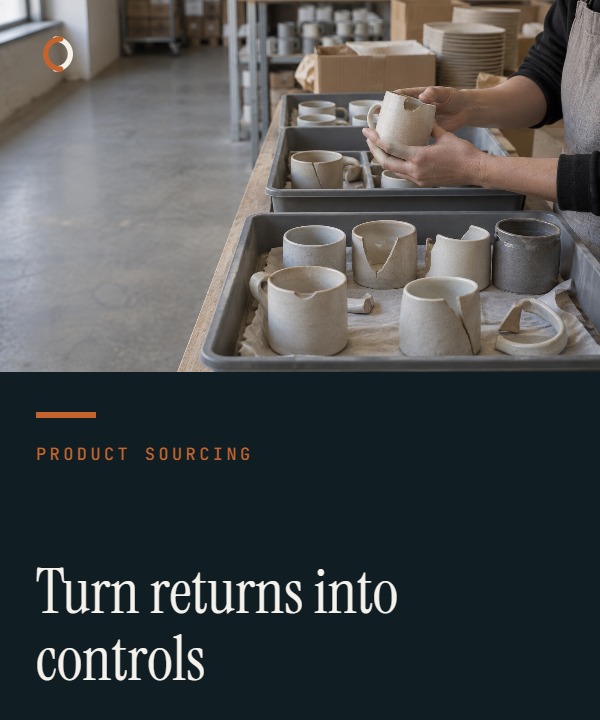
A return reason is a signal to investigate, not a verdict that the factory made a defective product. Build the quality loop at SKU and variant level: capture a consistent reason and minimum evidence, compare physical returns with the matching ordered- or fulfilled-unit denominator defined for the dataset, route the pattern to product, listing, packaging, fulfilment or another cause lane, and verify whether the selected action changes the result.
This prevents two expensive errors. The first is sending every return to the supplier as a quality complaint. The second is treating returns as a customer-service cost without feeding verified problems back into product controls.
Treat a return reason as a signal, not a factory verdict
The same dropdown reason can describe different events. “Damaged” could mean a manufacturing defect, an inadequate retail pack, parcel damage, a warehouse handling event or damage after delivery. “Not as described” could point to the product, but it could also expose an inaccurate image, missing dimension or unclear compatibility statement. “Wrong item” might begin with pick, barcode, listing or customer-return evidence.
Therefore, record what the customer selected without silently converting it into a cause. Preserve the original reason, then give the internal investigation a separate field for suspected cause and another for evidence-supported cause. Only traceable evidence of a supplier-controlled nonconformity should drive supplier attribution and a formal corrective-action demand.
Australian consumer guarantees and product-safety obligations operate independently of this analytics workflow. Handle the consumer matter under the obligations that apply; do not use an unresolved internal cause label to misstate consumer rights. This article does not decide the remedy in an individual case.
Capture one minimum event record at line-item level
Current Shopify Help documentation supports category-specific return reasons and line-item reporting. Other platforms vary, but the operating principle is transferable: record the event against the exact item, not only the order or customer.
For each returned line item, retain the minimum fields needed for the decision:
- SKU and variant identifier;
- order date, dispatch date, delivery date where available, and return-request or receipt date;
- channel and fulfilment path;
- standard return reason plus a concise factual note;
- ordered or fulfilled quantity for the comparison period, with the denominator definition retained;
- supplier, purchase order, production batch or receipt lot when traceability exists;
- package configuration and visible delivery or return condition;
- return disposition such as unopened, saleable, incomplete, damaged, quarantined or awaiting inspection; and
- links to relevant photos, support evidence or inspection records.
Do not copy customer names, addresses, health details or full support conversations into a quality-analysis sheet merely because the platform contains them. OAIC guidance for entities covered by the Australian Privacy Principles emphasises collecting only personal information reasonably necessary for their functions and taking a data-minimisation approach. Confirm which obligations apply to your business, restrict access under its applicable controls and prefer operational fields without direct identifiers where they can answer the quality question. This is a conservative workflow boundary, not a conclusion that a dataset is legally de-identified.
Separate physical returns from refunds and order reversals
A refund is not always a physical return, and an order edit is not evidence that a customer sent a product back. Shopify's current reporting documentation distinguishes returned quantity and returned quantity rate for physically returned line items from broader sales reversals, which can include refunds, cancellations and order adjustments.
Match the measure to the question:
- For product-condition analysis, use physically returned units that can be tied to the SKU and relevant evidence.
- For customer-friction analysis, include return requests even if the unit was not sent back, but label that population.
- For commercial impact, include refunds, replacements, reshipment, inspection, disposal and other relevant costs without calling all of them physical returns.
The denominator matters just as much. Shopify defines its returned quantity rate as physically returned units divided by ordered units. If an operator instead uses fulfilled units or another exposure denominator, name it and keep it consistent. Compare the same variant, period and, where possible, channel or fulfilment route. Comparing 20 returns from 20,000 eligible units with 10 returns from 200 would hide the more concentrated signal.
Route signals into five cause lanes
Use a stable first-pass taxonomy. It should be specific enough to send the investigation to the right owner but broad enough that staff can apply it consistently.
| Cause lane | Signals that may enter it | Evidence to request first | Initial control owner |
|---|---|---|---|
| Product, specification or production | Broken feature, inconsistent dimensions, finish defect, early failure, missing component | Returned unit, photos, controlled specification, batch or PO, inspection and test evidence | Product or quality lead |
| Listing or expectation | Size, colour, material, compatibility or performance differs from the customer's reasonable reading | Listing version, images, dimensions, claims, buyer questions and product measurement | Ecommerce or product-content owner |
| Packaging or transit | Crushed pack, abrasion, leakage, movement or impact after dispatch | Retail and shipper pack, carrier event, fulfilment route, damage location and returned package | Packaging or logistics owner |
| Pick, pack or fulfilment | Wrong SKU, wrong variant, missing part, barcode mismatch or incomplete kit | Pick record, barcode and label photos, kit checklist, warehouse or marketplace case | Fulfilment owner |
| Choice, use or unresolved | Change of mind, fit preference, misunderstood setup, insufficient evidence or conflicting accounts | Concise reason, relevant instructions and available evidence | Customer operations; route onward only if a pattern emerges |
These are investigation lanes, not final blame categories. A listing gap may originate in an incomplete specification. Transit damage may expose weak packaging. A wrong component could originate at factory kitting or local fulfilment. Let evidence move the record between lanes.
Compare like with like before ranking
Review at SKU and variant level first, then segment where the volume supports it. Useful comparisons include:
- ordered or fulfilled units and physically returned units in the same defined time window;
- reason and suspected-cause mix by variant;
- batch, purchase order or receipt lot;
- direct-to-consumer, marketplace and wholesale channels;
- fulfilment site, carrier or service;
- listing revision or packaging revision; and
- date the corrective action took effect.
Use count, rate and commercial consequence together. ASQ defines a Pareto chart as ranking frequency or cost from largest to smallest so the more significant categories are visible. That helps choose where to investigate first; it does not prove the largest category has one root cause.
Consider a fictional weekly review:
- SKU A had 2,000 eligible ordered units and 30 physical returns:
30 / 2,000 = 1.5%. - SKU B had 240 eligible ordered units and 12 physical returns:
12 / 240 = 5.0%. - SKU C had 600 eligible ordered units and eight physical returns:
8 / 600 = 1.3%, but three reports described overheating.
SKU A leads by count. SKU B has the highest concentration. SKU C requires immediate safety escalation despite the lower count. The example is not a benchmark; it shows why no single ranking should control every decision.
Investigate the pattern before assigning cause
Start with the strongest available evidence. Inspect returned units when safe and practical, or review clear photos and objective support records. Reconcile the result against:
- the current product specification and approved sample;
- the relevant critical, major or minor defect definition;
- the listing version the customer saw;
- retail and transit packaging requirements;
- pick, pack and barcode records;
- incoming inspection and batch-release records; and
- prior returns from the same variant, lot or route.
One photo may establish that damage exists, but not where it occurred. One selected reason may identify the customer's experience, but not the process that produced it. Record evidence strength: reported only, photo-supported, returned-unit inspected, batch-correlated or reproduced under a defined check.
NIST's process-monitoring guidance describes comparing current behaviour with prior performance and investigating departures. For a small operator, that can begin with a simple weekly trend rather than a complex statistical model. Compare each SKU with its own recent baseline and document notable shifts; do not invent control limits or declare a process change from one isolated point.
Move safety reports into a separate fast lane
Safety-related reports do not wait for a weekly Pareto ranking. If a return, complaint or support message describes injury, illness, overheating, electric shock, fire, choking, structural collapse or another potential hazard:
- preserve the original report and product identifiers;
- stop routine resale or disposal of the relevant returned unit;
- quarantine related stock where the responsible safety process requires it; and
- escalate immediately to the person responsible for product safety and current official procedures.
Product Safety Australia states that participants in the consumer-goods supply chain, including importers and sellers, can have mandatory-reporting obligations when they become aware of a death, serious injury or serious illness associated with a supplied consumer good. Use the regulator's current guidance to assess the event and deadline. This article does not decide whether a particular event is reportable or whether a recall is required.
As an OPL routing rule, frequency does not control the safety lane. A credible high-severity report is escalated under the responsible safety process before routine Pareto prioritisation; that escalation is not itself a reporting or recall conclusion.
Route a verified cause into the right control
Once evidence supports a cause, change the control that can prevent recurrence.
- Product definition: update the controlled product specification, test method, acceptance criterion or approved reference through change control.
- Supplier production: open a supplier corrective action with the affected batch, defect evidence, containment and effectiveness requirement.
- Listing: correct the relevant dimensions, compatibility, images, material description, instructions or other unsupported expectation.
- Packaging: revise the product-package requirement and validate the changed configuration against the intended distribution route.
- Fulfilment: correct barcode, slotting, pick verification, kit completeness or handling controls with the responsible operator.
- Receiving: change the targeted incoming inspection only when the return evidence identifies a characteristic that can be detected at receipt.
Avoid the reflex to add more inspection to every problem. Inspection cannot correct a misleading listing, and a supplier cannot control a local warehouse pick error. Route the evidence before allocating the action.
Verify the action and keep the audit trail
A closed ticket is not proof of improvement. For every corrective action, record:
- the affected SKU, variant, batches, channels or fulfilment routes;
- the evidence-supported cause and remaining uncertainty;
- the action, owner and effective date;
- the first production, receipt or listing revision affected;
- the measure and comparison window; and
- the result, including any new or shifted reason pattern.
Then compare like periods after enough relevant sales or exposures have occurred. If the original signal persists, reopen the investigation. If one reason falls while another rises, check whether staff recoded the same problem or the action shifted rather than removed it.
Connect return losses to the wider cost-of-poor-quality calculation, but keep the analysis transparent. Returned product value, reshipment, support time, inspection, rework, disposal and lost margin are different cost elements; avoid double-counting them.
Start with a regular SKU review
A useful first version does not require a new analytics platform. A small team might begin with a weekly cut-off, but the cadence should reflect sales volume, signal severity and the responsible safety process. At each review, ask:
- Which SKU or variant has the highest physical-return count, rate and material cost under the defined denominator this period?
- Which reasons changed against that SKU's own recent pattern?
- Are the events concentrated by batch, listing version, package, channel or fulfilment route?
- What evidence exists beyond the selected reason?
- Does any report belong in the immediate safety fast lane?
- Which owner should gather the next evidence, and by when?
- Which prior action has enough exposure for an effectiveness check?
The goal is not to make every return fit a factory-defect narrative. It is to turn post-sale evidence into the right product, content, packaging, logistics or supplier control—and to show whether that control worked.
Sources
- Shopify Help: Creating and processing returns and exchanges
- Shopify Help: Sales reports
- ASQ: What is a Pareto Chart?
- NIST/SEMATECH e-Handbook: What are Process Control Techniques?
- ACCC: Consumer rights and guarantees
- Product Safety Australia: Who must submit a mandatory report
- OAIC: APP 3 collection of solicited personal information
Not sure the supplier is real?
We check the factory before you pay: registry and litigation screening, a day on site at each shortlisted factory, and one written recommendation.
See how supplier vetting works →Get the goods checked before you pay the balance.
Our inspectors check production at the factory, mid-run and before shipment. They're paid by you, not the factory, so they work for you.
See quality control →Shipping from China to Australia?
We consolidate orders from several suppliers at our Guangzhou warehouse and coordinate the move with licensed forwarders, with one point of contact from factory to your warehouse.
See freight services →Need a factory that can make it?
We find and vet suppliers, including capable smaller factories that are more flexible on MOQ and terms, negotiate in Mandarin, and get samples to your desk before anything is committed.
See product sourcing →


