

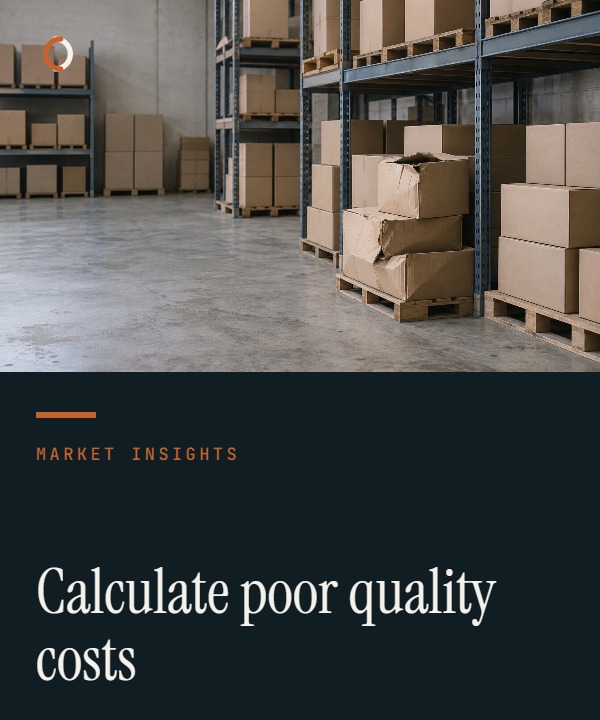
The cost of a defective import order is not just the value of the rejected units. It is the labour used to sort them, the rework and reinspection, extra freight and storage, customer remedies, support time, platform costs and the contribution lost while saleable stock is unavailable.
For a useful decision number, calculate these defect-triggered costs, deduct only recoveries that have actually been realised, and keep uncertain opportunity or reputation effects in a separate scenario. That produces a number you can compare across products, orders and suppliers without hiding assumptions.
Cost of quality and cost of poor quality are not the same
Quality practitioners commonly divide the total cost of quality into four groups: prevention, appraisal, internal failure and external failure. Prevention covers work intended to stop defects. Appraisal covers inspection and testing. Internal failures are found before release to the customer; external failures emerge after release.
This distinction prevents a common accounting mistake. A planned pre-shipment inspection is normally an appraisal cost—the price of control—not automatically a cost of poor quality. A second inspection ordered because the batch failed, extra sorting caused by nonconformance, or rework verification is defect-triggered failure response and belongs in the incident's poor-quality ledger.
Gross measured COPQ = internal failure cost + external failure cost
Net measured COPQ = gross measured COPQ - realised recoveries
Scenario economic impact = net measured COPQ + estimated opportunity cost
Keep the three outputs visible. The measured number supports accounting and supplier discussions. The scenario number helps management decide how much risk reduction may be worth buying.
Build the evidence trail before building the total
Open one incident record for the canonical product, purchase order and affected lot. Record when the issue was first detected and which units are confirmed, suspected, unaffected or already sold. Link the current specification revision, approved sample, inspection reports, photographs, test results, freight records, return reasons, support tickets and supplier correspondence.
Do not allocate every damaged unit to “factory quality” by default. Manufacturing nonconformance, packaging failure, transit damage, warehouse handling and customer misuse can create different cost owners and remedies. Record the cause as unconfirmed until evidence supports it. The cost can still be measured while responsibility is unresolved.
- invoice or credit note for third-party spend;
- payroll-loaded hourly rate and tracked time for internal labour;
- landed unit cost record for scrapped or replacement inventory;
- warehouse statement for quarantine and storage;
- platform or payment statement for non-refundable fees;
- return reason and disposition for customer remedies; and
- written, realised supplier or insurer recovery.
A requested supplier credit is not cash. Show it as pending recovery until it is received or recognised under the business's accounting policy.
Calculate internal failure cost
Internal failure costs arise before the importer releases affected units to customers. For a China-sourced order, the ledger often includes the following.
| Cost line | Calculation | Evidence |
|---|---|---|
| Sorting | Hours × loaded labour rate, or contractor invoice | Timesheet or invoice |
| Rework | Units reworked × cost per unit | Work order and parts/labour record |
| Scrap | Units written off × landed unit cost, less salvage | Inventory adjustment |
| Reinspection | Incremental inspection or testing caused by failure | Inspection invoice/report |
| Quarantine | Days or pallet positions × storage rate | Warehouse statement |
| Replacement freight | Incremental freight to restore saleable supply | Freight invoice |
| Production interruption | Documented idle or changeover time × relevant rate | Production or operations record |
The baseline inspection should remain in the appraisal budget. Include only the incremental work caused by the defect event in COPQ. This lets the business compare control investment with the failure cost it is intended to reduce.
If the root issue is an unclear specification or acceptance rule, use the result to build a product-specific quality-control plan. If the main question is when a defect could have been found, choose the inspection point that matches the main failure risk. Those are prevention decisions; this ledger prices the consequence.
Calculate external failure cost
External failure starts when a nonconforming unit has been released to the customer or channel. It may include customer-service time, return freight, replacement fulfilment, inventory write-off, non-refundable fees, marketplace remediation, distributor chargebacks and recall execution.
Australian consumer obligations make this more than a factory dispute. The ACCC says a business that sold a product which does not meet the consumer guarantees must provide the applicable remedy and must not simply direct the customer to the manufacturer. Depending on the circumstances, consumers may also be entitled to compensation for additional damage or loss.
The Australian Consumer Law's definition of manufacturer can also include an importer where the actual manufacturer has no place of business in Australia. The precise position depends on the supply chain and facts, so the cost model is not a substitute for legal advice.
Australian suppliers can have statutory reimbursement rights against a manufacturer in specified circumstances. That does not make an overseas factory credit automatic or collectible. Keep customer-remedy work in gross COPQ; record a supplier reimbursement separately when it is realised.
Safety defects require a different response from ordinary cosmetic or performance nonconformance. ACCC guidance identifies safety, recall and mandatory-reporting responsibilities for sellers, importers and other supply-chain participants. If a defect could make a consumer product unsafe or non-compliant, stop ordinary commercial disposition and obtain appropriate product-safety and legal guidance. Do not wait for the spreadsheet to be complete.
When counting refunds and replacements, use a consistent basis. One method is to count the sunk product, fulfilment, return and replacement costs, then show lost contribution separately. Adding the full refund value, the inventory write-off and lost margin for the same unit can count the same economic loss more than once.
Worked example: a defect erodes 17.6% of expected contribution
Consider a hypothetical Australian ecommerce importer with a 5,000-unit order. The expected contribution before defect costs is AUD 10 per unit, or AUD 50,000 for the order. The business confirms 400 nonconforming units across receiving checks and customer returns.
These figures are illustrative, not an industry benchmark or OPL customer case.
Internal failure ledger
| Item | Calculation | Cost (AUD) |
|---|---|---|
| Receiving sort | 40 hours × $38 | $1,520 |
| Rework | 180 units × $3.80 | $684 |
| Scrap | 40 units × $12.40 landed unit cost | $496 |
| Defect-triggered reinspection | Invoice | $650 |
| Expedited replacement freight | Invoice | $1,300 |
| Quarantine storage | 21 days × $35 | $735 |
| Internal failure total | $5,385 |
External failure ledger
| Item | Calculation | Cost (AUD) |
|---|---|---|
| 40 refunded orders | 40 × ($12.40 stock + $4.20 fulfilment + $9 return freight) | $1,024 |
| 20 replacements | 20 × ($12.40 replacement + $4.20 handling + $9 dispatch) | $512 |
| Customer support | 18 hours × $38 | $684 |
| Non-refundable platform/transaction fees | Statement | $180 |
| External failure total | $2,400 |
The incident is also expected to delay or prevent 200 unit sales, including the 40 refunded orders already represented in the external-failure ledger. Management tests an opportunity-cost scenario using the AUD 10 contribution per unit. This contribution effect is kept separate from the refund-handling costs so the two are not added twice:
$5,385 internal + $2,400 external = $7,785 gross measured COPQ
$7,785 - $1,000 realised supplier credit = $6,785 net measured COPQ
200 delayed sales × $10 contribution = $2,000 estimated opportunity cost
$6,785 + $2,000 = $8,785 scenario impact- AUD 8,785 ÷ 5,000 ordered units = AUD 1.76 scenario impact per ordered unit after rounding;
- AUD 6,785 ÷ 400 confirmed defective units = AUD 16.96 net measured COPQ per confirmed defective unit; and
- AUD 8,785 ÷ AUD 50,000 expected contribution = 17.6% scenario margin erosion after rounding.
That does not prove an inspection would have saved AUD 8,785. It tells the buyer the size and composition of this incident. The next control should target the dominant, preventable cost driver and then be measured across later orders.
The defect rate alone is not the decision. A small number of safety-critical failures can matter more than many cosmetic issues. Define defect severity before inspection, then use actual costs to understand commercial impact.
Treat reputation as a signal before treating it as dollars
Reputation damage is real but easy to inflate. Do not assign an arbitrary dollar amount to a rating change or a bad review. Track the signals first:
- defect-related return and complaint rate;
- rating or review trend for the affected SKU;
- cancelled orders during an out-of-stock or listing restriction;
- repeat-purchase change in a comparable customer cohort;
- support contacts per affected order; and
- confirmed wholesale or marketplace penalties.
If management needs a scenario, expose the formula. For example, estimated lost units × contribution per unit is auditable. Label it as an estimate and show a range when volume attribution is uncertain.
Importer discussions on Reddit repeatedly raise fears about bulk quality differing from samples, defects appearing only after fulfilment, negative reviews and difficulty recovering money from a supplier. These accounts are useful prompts for the ledger, but they are individual, often non-Australian experiences. They do not establish a defect-rate benchmark or prove what any supplier will repay.
Turn COPQ into a sourcing decision
First, rank the incident's cost lines from largest to smallest. Then group them by defect mode, detection point and suspected cause. A high-cost repeat mode is a stronger target than a long list of minor findings.
Second, choose a control tied to that mode. The answer may be a measurable specification, approved sample control, process check, packaging test, earlier inspection, supplier corrective action, smaller exposure or a different supplier. Do not buy more inspection without stating which failure it is expected to detect and what decision will follow.
Third, compare control cost with avoidable failure cost across multiple orders. A new control is useful if it reduces the relevant failure frequency or consequence without creating a larger cost elsewhere. One clean order is not enough to claim causation.
Fourth, feed the historical result into sourcing. When you normalise supplier quotations, add an expected-quality adjustment based on product- and supplier-specific evidence. Keep this separate from the normal landed-cost model and show the uncertainty. A cheaper unit price can be commercially worse if the supplier repeatedly transfers sorting, delay and customer-remedy costs to the importer.
If a batch has already failed before shipment, use the separate guide to decide what to do when a shipment fails inspection. That guide owns the rework, reinspection, negotiation or rejection decision; the COPQ ledger records what the chosen path costs.
What to do next
Close each defect incident with five outputs: confirmed affected quantity, root-cause status, gross measured COPQ, realised recovery and a separately labelled opportunity-cost scenario. Preserve the evidence needed for supplier discussion, customer remedies, insurance, accounting and any regulator or marketplace response.
Then update the supplier and product risk record. Use the largest controllable cost—not the most visible complaint—to choose the next preventive or appraisal action. Escalate a potential safety, compliance or legal issue immediately. For ordinary quality failures, the goal is simple: make the cost visible enough that the next sourcing decision reflects the true price of the supplier's performance.
Sources
- ASQ: Cost of quality
- ACCC: Repair, replace, refund, cancel
- ACCC: When manufacturers must reimburse suppliers for remedy costs
- ACCC: Product safety responsibilities
- ACCC Product Safety: Recall an unsafe product
- Competition and Consumer Act 2010, Schedule 2
Sources retrieved 10 August 2026 Australia/Sydney. This article provides general operational information, not legal, product-safety, accounting or financial advice.
Not sure the supplier is real?
We check the factory before you pay: registry and litigation screening, a day on site at each shortlisted factory, and one written recommendation.
See how supplier vetting works →Get the goods checked before you pay the balance.
Our inspectors check production at the factory, mid-run and before shipment. They're paid by you, not the factory, so they work for you.
See quality control →Shipping from China to Australia?
We consolidate orders from several suppliers at our Guangzhou warehouse and coordinate the move with licensed forwarders, with one point of contact from factory to your warehouse.
See freight services →Need a factory that can make it?
We find and vet suppliers, including capable smaller factories that are more flexible on MOQ and terms, negotiate in Mandarin, and get samples to your desk before anything is committed.
See product sourcing →


