

Match the certificate to the transaction before relying on it
To check a Chinese supplier's ISO 9001 certificate, reconcile the complete certificate with the named holder, disclosed production site, literal scope, issuer and current recorded status. Save the result with a date and the transaction it supports. A certificate number that appears in a database is a useful starting point; it does not answer whether the document belongs to the company and site proposed for your order.
For an Australian importer, the practical deliverable is a bounded evidence record. It should show what matched, what differed, what still needs issuer clarification and who owns the next action. Avoid closing the supplier file with a general ISO verified label that procurement might later read as approval of the factory or product.
The reconciliation record below is proposed OPL operational analysis, rather than a certification procedure or professional assurance opinion. It checks documentary correspondence. It does not determine ISO conformity, interpret formal certification scope, establish Australian product compliance or approve a supplier. Where interpretation matters, obtain input from the issuing body and an appropriately qualified certification specialist.
Decide which claim you are checking
Start by writing down the supplier's actual claim. We have ISO 9001 could refer to the seller, a related manufacturer, a group company or a particular site. Before searching, ask which entity holds the certificate and which entity will make the goods. Keep those two questions separate from who issues the invoice or arranges export.
ISO's certification guidance explains that ISO develops standards and does not issue certificates. Certification is performed by external bodies. The same guidance distinguishes accreditation of the certification body from certification of the organization. A marketplace badge or use of the ISO name is therefore not the evidence record you need.
Define a narrow checking objective, such as: reconcile the supplied certificate with the seller and disclosed producer for purchase order revision B. This anchors the review to an actual arrangement without turning it into a judgment on the supplier's entire business. If the manufacturer changes while the seller remains the same, the original comparison needs to be revisited.
Assemble the complete document pack
Ask for a readable certificate, every referenced annex or site schedule, the holder's exact name, the standard edition as printed, the full certificate number and the issuer's name. Keep the supplier's covering message because it explains what the document was offered to support. A cropped image can conceal a site limitation or omit the part directing you to an annex.
Bring in the supplier identity already established through your Chinese business licence check. Use that verified identity as an input rather than repeating the company-registration investigation. Also collect the quotation, proposed purchase order and disclosed production-site address. If the seller and producer differ, retain the supplier's explanation of their relationship.
Keep source-language files alongside working translations. Record uncertain translations explicitly, especially when an activity or address could change the comparison. Similar English names are a reason to check the source details, not a basis for deciding that two entities are interchangeable.
Create a document index before making annotations. Assign a file reference and receipt date to the certificate, annex, identity evidence and commercial documents. Preserve the unmodified originals. This lets a later reviewer distinguish a field supplied by the vendor from a field returned by an authoritative lookup or added in a buyer's note.
Build a dated certificate-to-transaction record
Use one record for the certificate and declared transaction arrangement. If several certificates or production sites are involved, give each a separate comparison within the same supplier file. Combining them into a single green cell hides which evidence supports which company or activity.
| Record field | Evidence to preserve | Comparison and limitation |
|---|---|---|
| Review context | Check date, reviewer, order or sourcing decision, document revisions | Identifies the arrangement checked, not every future order |
| Holder identity | Exact name and identifiers shown; established supplier identity | Record literal matches and unexplained differences |
| Seller and producer | Commercial counterparty and disclosed producing entity | State separately whether either is the named holder |
| Certified locations | Certificate address and complete site schedule | Record listed addresses; do not infer coverage from proximity |
| Scope and edition | Exact activity wording and full standard edition | Preserve wording; ask the issuer about material ambiguity |
| Certificate and issuer | Full number, issuer name, issue/expiry fields | Compare document particulars with returned records |
| Claimed accreditation | Body named or mark claimed, source used to check it | Keep issuer accreditation separate from supplier certification |
| Result and follow-up | Lookup response, access time, mismatch, owner and next action | State what is confirmed and what remains unresolved |
Treat the last row as the working conclusion. A record can contain matching identity details and an unresolved production-site question at the same time. Avoid averaging these into an overall confidence score. Procurement needs to see the unresolved issue directly before deciding how much weight to give the certificate.
Use official verification routes
IAF CertSearch's general FAQ describes a database of accredited management-system certificates. Its records can expose the certificate status, standard, scope, locations, certification body and accreditation body. The database does not cover product certification or non-accredited certificates. Use it for the particular certificate-record question it can answer.
The certificate verification guide provides the organization/certificate lookup workflow. Search using the full identifier or the holder details available to you, then compare the returned fields with the supplied document. Save the query keys and result rather than recording only that you visited the website. Account access and tool features can vary; follow the current interface instructions.
For certificates claiming the CNAS accreditation mark, CNAS's certificate-query page directs users to CNCA's national certification and accreditation information public-service platform, within the certification-results section. The CNCA internet-services page links to that platform. Start from the official landing page so a changed interface does not lead you to an unrelated commercial service.
If access is unavailable, record the failed route and time. Do not treat a login barrier, CAPTCHA or empty screen as a certificate finding. ISO's guidance also identifies direct confirmation with the relevant certification or accreditation body as a verification route. Find that body's contact channel independently, then retain the substantive response when one is received.
Read returned status without expanding its meaning
Write the status exactly as displayed, together with the source and check time. Keep printed issue and expiry dates distinct from the current returned status. If a record is historical, unclear or inconsistent with another source, preserve the difference and ask the issuer to clarify it.
CertSearch's certificate-number instructions say suggestions can include active, suspended, withdrawn and expired records. They also explain that an absent suggestion may reflect a certificate not yet added, confidentiality or removal, and provide an inquiry route. Absence is an unresolved lookup, not proof of forgery. Likewise, the existence of a search result does not mean its status is active.
Do not turn a recorded status into a verdict on the whole supplier. A current matching record can still belong to a different entity from the proposed producer. An unexplained record difference deserves a question, but the buyer should not assign it a cause such as fraud, administrative error or suspension without evidence.
Keep the standard edition as printed and ask the issuer about any material edition question. This workflow supplies no transition deadline and does not decide whether an older edition remains eligible under a particular scheme. Those questions require the applicable instructions and qualified interpretation when they affect the decision.
Separate literal correspondence from scope interpretation
Compare the disclosed plant address with every location supplied in the certificate pack. A supplier's sales office and a production plant may be different places; record the difference plainly. Do not assume that a nearby address, shared logo or group relationship adds an unlisted site to the certificate.
Read the activity wording in the same way. If the document states sales and the supplier proposes manufacturing elsewhere, the immediate output is an unresolved correspondence question. It is not a buyer-issued conclusion that the certification is invalid. Ask the issuer which listed records and annexes are relevant and whether more documentary evidence is needed.
The distinction matters particularly for broad or translated wording. A procurement employee can transcribe an activity and flag a mismatch without claiming the competence to interpret formal certification boundaries. If the answer needs that interpretation, stop the documentary conclusion and involve the appropriate specialist.
Once this record is complete, site capability remains a separate job. The China factory audit checklist addresses evidence about production controls and the proposed operation. Linking the two files helps the buyer see what each check contributes without treating a document lookup as observation of the factory.
Worked example: a production change reopens an earlier match
This example is entirely fictional. Seller A, Producer B, Producer D, Plant P, Plant Q and Certificate C are placeholders. All document details, lookup outcomes and events are invented to demonstrate the record; no real investigation or issuer response is represented.
At the first sourcing review, Seller A's quotation identifies Producer B at Plant P. The supplier supplies Certificate C naming Producer B and listing Plant P. Assume, only for this example, that the buyer's official lookup returns the same number, holder and listed address with an active status. The buyer records a documentary match for those specified fields and keeps the exact activity wording. It has not determined formal scope coverage, product conformity or whether to approve the order.
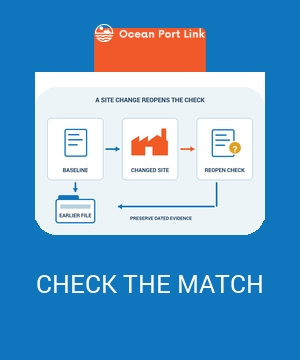
Before the proposed purchase order is finalized, Seller A sends a revised production plan naming Producer D at Plant Q. It attaches the same Certificate C. The old lookup is still evidence of what was returned at the first review. It does not establish a documentary match between Certificate C and the newly disclosed producer or plant.
Preserve the first record and add a new comparison against the revised arrangement. This prevents a green result from the earlier review being carried forward without its original context.
| Review event | Evidence preserved | Field finding and limitation |
|---|---|---|
| First sourcing review | Certificate C; Producer B/Plant P plan; assumed active lookup matching number, holder and listed address | Those fields matched for that arrangement at that time; formal scope and supplier approval were not decided |
| Revised production plan | New plan names Producer D/Plant Q; supplier resends Certificate C | Disclosed producer and plant differ from the recorded holder and listed site; current-transaction correspondence is open |
| New lookup | Current query keys, returned fields and status, or access failure | Record the fresh result separately; an unchanged active result does not resolve the changed producer/site comparison |
| Closeout request | Complete new pack or relevant annex; independently sourced issuer response; comparison revision | Update only fields supported by the new evidence; ambiguous coverage remains a specialist question |
The purchasing lead marks certificate reliance for the revised arrangement as evidence pending and assigns the comparison to the quality lead. The quality lead asks Seller A for the complete documentary pack offered for Producer D and Plant Q. It also asks the issuer about the named records and annexes, quoting Certificate C and the literal discrepancy. It does not ask the issuer to approve the supplier or guarantee the goods.
Two different updates are possible, neither assumed to have occurred. If the production change was reported incorrectly and a corrected documented arrangement still identifies Producer B at Plant P, preserve the correction and repeat the current comparisons. Do not delete the intervening discrepancy. If production genuinely moved, compare the supplied records for the new entity and site; a new certificate or annex must be checked on its own particulars rather than inheriting the earlier result. If evidence remains absent or formal coverage is ambiguous, keep reliance unresolved and obtain the needed qualified interpretation.
A useful change-log entry identifies the review version, changed producer/site fields, source of the change, fresh lookup result, open question and owner. Close only the documentary questions the received material actually resolves. The previous match remains in the file as a dated finding for the earlier arrangement, while the current decision carries its own limitation.
Ask a question the issuer can answer
Keep the inquiry factual and focused. Provide the complete certificate number, holder name, document date, listed address and the discrepancy. Ask for confirmation of the current recorded particulars and any relevant annex. Avoid asking whether the supplier is trustworthy or whether your future goods will conform; those questions go beyond this check.
Retain your request and the received response as separate records. Until a substantive response arrives, use issuer-response pending. If a response refers to another document, obtain and index that document before updating the conclusion. A phone conversation should be captured in a dated note and followed by a request for written confirmation of material points.
Carry the limitation into supplier approval
Use three documentary outcomes: match for specified fields, mismatch requiring resolution, or evidence pending. Add a sentence explaining the commercial relevance. For example, a seller-only match can be entered into the supplier file while the plant correspondence remains open; the approval decision must still account for that limitation.
The supplier evaluation scorecard is a separate decision tool. Transfer the exact evidence outcome into it without silently upgrading the finding to factory capability or product quality. A certificate lookup cannot replace samples, order-specific inspection, testing or other required compliance evidence.
Revisit the record when the disclosed entity, site, certificate pack or transaction arrangement changes, and before reusing an old check for a material decision. Keep the previous version so another reviewer can see what was known at each point. Start with one pending sourcing decision, build the record, and resolve the material correspondence gaps before relying on the certificate.
Sources


.png)
