

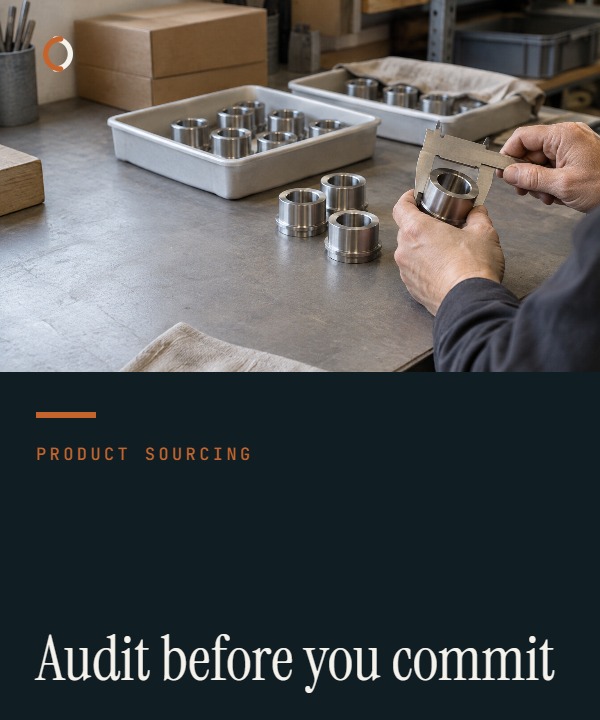
A China factory audit should test whether the disclosed production site can control your proposed order—not whether the reception area is tidy or the supplier can complete a generic questionnaire. Define the product, order, audit objective and decision criteria first. Then follow a representative order through requirement review, incoming materials, storage, production, inspection, nonconforming control, packing and release while sampling current records.
The minimum output is not a percentage score. It is an evidence-based decision: proceed, proceed only after specified actions, run a narrower technical or social audit, verify a finding on site, or stop.
This checklist is general operational guidance. A regulated product, complex process, labour/human-rights risk or legal question may require a qualified technical expert, accredited laboratory, specialist auditor or legal adviser.
Know what the audit is—and is not
A buyer or second-party factory audit can combine product/process capability questions with selected quality-management-system controls at the proposed site. It does not certify the factory or declare conformity with ISO 9001. A product inspection examines units or a lot against defined product criteria. A laboratory test measures specified characteristics using a defined method. A social, labour, environmental or health-and-safety audit uses different criteria and specialist competence.
One activity cannot silently stand in for all four.
| Activity | Primary question | Typical evidence | What it does not establish alone |
|---|---|---|---|
| Buyer factory capability/selected-QMS audit | Can this site control the proposed production processes and requirements? | Process observation, interviews, current records, resources, responsibilities and findings | Certification, ISO 9001 conformity or assurance that the future shipment conforms |
| Product inspection | Does the sampled product or lot meet the defined inspection criteria at this stage? | Measurements, functional checks, defect records, quantity and packaging checks | That the wider management system is effective |
| Laboratory test | Does the tested sample meet the specified test method or requirement? | Laboratory report, method, sample identity and result | That untested production is identical or all legal duties are met |
| Social/environmental specialist audit | What conditions and controls exist against the selected labour, human-rights, safety or environmental criteria? | Worker interviews, records, site evidence and specialist findings | That every tier, time period or hidden impact has been examined |
ACCC Product Safety advises Australian consumer-product suppliers to check compliance when sourcing, including factory controls, raw-material testing, followed assembly processes, quality checks, pre-shipment inspection and current staff training. It also says the Australian supplier is legally responsible for product safety. A factory audit is therefore one control in a wider product-compliance system, not a transfer of responsibility.
Build the audit around a decision
Write the decision before writing the checklist. For example:
Determine whether Site X can produce 12,000 units of Product Y to specification revision C within the stated production window, using the disclosed materials and processes, with acceptable quality, traceability and change control.
Then define five audit elements.
- Objective: the decision the audit must inform.
- Scope: entities, sites, products, processes, shifts, subcontractors and time period included.
- Criteria: the buyer's specification, contract requirements, applicable management-system criteria and product-specific regulatory requirements.
- Evidence plan: interviews, observations and sampled records needed to reach reasonable confidence.
- Competence: the technical, language, audit and regulatory knowledge the audit team needs.
ISO 19011:2026 provides guidance on audit principles, audit programmes, conducting management-system audits and auditor competence. It is used here as methodology guidance; applying it does not turn a buyer audit into certification. ISO/IAF Auditing Practices Group guidance adds an important practical warning: a checklist can keep the audit on scope, but it should not prevent the auditor following new evidence or process interfaces.
Do not buy a generic “factory audit” without reading its scope. An audit of one address and one product family may not cover the site, subcontractor, shift or process proposed for your order.
Request evidence before the visit
The pre-audit request tests preparedness and gives the auditor time to select samples. Ask for documents relevant to the proposed order, not a large undifferentiated data room.
- Chinese legal name, Unified Social Credit Code and registered address.
- Contracting seller, payment beneficiary and physical production-site details.
- Organisation chart and named owners for sales, engineering, purchasing, production and quality.
- Site/process layout and a high-level process flow for the product family.
- Equipment list for material production and inspection steps.
- Current management-system certificates and stated scopes, if relied upon.
- Relevant procedures for document/change control, purchasing, incoming inspection, production, nonconforming output and corrective action.
- Recent records suitable for sampling, with other customers' confidential information protected.
- Current load, planned shutdowns and the basis of the quoted lead time.
- Proposed subcontracted or special processes.
- Product-specific test reports, declarations or technical files claimed in the quotation.
Treat refusal, delay or redaction proportionately. Confidentiality can justify protecting customer names or pricing. It does not justify withholding every record needed to assess whether a process is implemented.
Reconcile the entity and the site
China's National Enterprise Credit Information Publicity System can provide registration information such as the company name, Unified Social Credit Code, registered address and business scope. Compare those fields with the quotation, contract, invoice, certificate and visit address.
Record separately:
- legal entity being audited;
- contracting seller;
- payment beneficiary;
- site visited or connected remotely;
- site that will manufacture the order;
- owner or operator of key equipment and tooling; and
- disclosed subcontractors or sister companies.
A legitimate group structure or trading relationship may involve several entities. The audit concern is an unexplained or changing structure that breaks accountability. A registration record does not prove the site owns equipment, makes the product or controls the proposed order.
Verify management-system certificates separately. IAF CertSearch can help check the entity, site, standard, status and scope of accredited certificates in its database.
Follow one representative order through the factory
Avoid auditing only by ISO clause or department. Follow the proposed order across process interfaces. At each step, compare what people say, what documents require, what records show and what is visible.
| Process step | Ask and observe | Sample evidence | Common unresolved question |
|---|---|---|---|
| Requirement review | Who converts the RFQ, drawing and specification into production requirements? | Contract-review record, feasibility review, approved revision | Did production receive the same requirement the buyer approved? |
| Purchasing and subcontracting | How are material/component sources selected and changes controlled? | Approved supplier record, purchase order, incoming specification | Can an upstream source change without buyer approval? |
| Incoming material | How are identity, quantity and critical characteristics checked? | Receiving record, material certificate, incoming inspection result | Is rejected material identified and segregated? |
| Storage and traceability | How are status, lot, shelf life and environmental needs controlled? | Labels, location records, stock rotation and conditions | Can the material used in a finished lot be traced? |
| Production setup | Who approves tooling, settings, first-off units and work instructions? | Setup sheet, first-piece approval, current work instruction | Are settings and revisions controlled at the workstation? |
| In-process control | Which characteristics are checked, by whom and at what frequency? | In-process record, gauge ID, reaction plan | What happens when a result is out of limit? |
| Nonconforming output | How is suspect product contained, reviewed and dispositioned? | Quarantine log, concession/rework approval, reinspection | Can rejected product return to the flow without authorised release? |
| Final inspection and release | Who confirms product, quantity, packaging and required records before shipment? | Final record, release approval, packing specification | Is release independent of schedule pressure? |
| Complaints and corrective action | How are recurring failures analysed and prevented? | Complaint trend, cause analysis, action and effectiveness check | Did the response remove the cause or only repair the sample? |
Start with a recent completed order, then trace a current order on the floor where possible. Choose records based on risk and contradictions, not a fixed universal count. ISO/IAF guidance notes that there is no single mathematical sample number for a management-system audit; the auditor seeks enough evidence to have confidence in implementation.
Challenge capacity with the proposed order
“Monthly capacity” is not useful until its assumptions are visible. Build a capacity challenge around the bottleneck process.
Start with:
- required good units;
- available production weeks after approvals, material procurement and planned shutdowns;
- line or machine intended for the order;
- demonstrated cycle or output basis;
- shifts and staffed hours;
- setup and changeover time;
- planned maintenance and realistic downtime assumption;
- expected yield, rework and scrap treatment;
- current committed load; and
- capacity reserved for other customers or products.
The first arithmetic test is simple:
required good output per available week = order quantity ÷ available production weeks
Then compare that required output with the factory's demonstrated good-output capacity at the bottleneck—not the theoretical nameplate rate of the fastest machine.
For example, an illustrative 12,000-unit order with six available production weeks requires 2,000 good units per week. If recent records for the proposed bottleneck show 1,850 good units per week after rejects and downtime, the evidenced plan is short by 150 units per week, or 900 units over six weeks. The factory would need a documented, credible change to capacity or schedule; a 2,500-unit nameplate claim does not close the gap.
| Capacity claim | Evidence to seek | Stress question |
|---|---|---|
| Machine or line rate | Time-stamped production record, cycle observation and good-output count | Does the rate include changeover, downtime, rejects and inspection? |
| Available hours | Shift roster, staffing, maintenance plan and current schedule | Are trained operators and supporting processes available? |
| Current load | Production plan and committed-order view | Which orders compete for the same bottleneck? |
| Material readiness | Purchase lead times, approved sources and inventory status | What happens if a critical material is late or rejected? |
| Expansion or overflow | Approved backup line/site and transfer controls | Is overflow already qualified, or merely a sales promise? |
Record assumptions and sensitivity. Capacity evidence supports a planning decision; it does not guarantee output. A technically capable site can still miss a schedule if the quotation ignored material lead time, approvals, holidays, maintenance, yield or competing load.
Link the capacity result to the supplier production and quality controls, not only the sales lead time.
Test whether the quality system is used
A procedure's presence answers “is there a document?” The audit must also ask whether people use it and whether outputs show the process is effective.
Document and change control
- Is the current specification revision available where work occurs?
- Are obsolete drawings or work instructions removed or clearly controlled?
- Who approves material, process, tooling, packaging and subcontractor changes?
- Can the factory show a recent change from request through approval and implementation?
Competence and work instructions
- Which roles affect critical product characteristics?
- What competence criteria apply, and how is competence evaluated?
- Do operators understand the relevant acceptance and reaction rules?
- Are temporary or reassigned workers controlled for the task?
Monitoring and measuring resources
- Which measurements determine acceptance?
- Is the equipment suitable for the range, resolution and method?
- Can its status be identified at the point of use?
- What happens to product accepted with equipment later found unsuitable or out of status?
Supplier and subcontractor control
- Which external providers affect critical materials, parts or special processes?
- How were they approved and how is performance monitored?
- Are buyer requirements flowed down in purchase documents?
- Can a subcontractor change without notice and approval?
Nonconforming product and corrective action
- Is suspect product identified, segregated and prevented from unintended release?
- Are rework instructions approved and followed by reinspection?
- Does cause analysis distinguish a one-off correction from action that prevents recurrence?
- Is effectiveness checked after implementation?
The live OPL guides to product specifications, golden samples and quality control plans provide the product-level inputs this system must control.
Test Australian compliance evidence without overclaiming
The audit should connect the factory's records to the product's Australian requirements. It should not issue a broad statement that the product is “Australian compliant” without defined criteria and competent review.
For a consumer product, ACCC Product Safety recommends checking applicable requirements, sourcing from suppliers with appropriate controls, verifying raw materials and processes, using suitable testing, and carrying out pre-shipment and ongoing checks. The importer should identify the rules before the audit and give the auditor a product-specific evidence plan.
Check, as relevant:
- exact product/model and sample identity on test reports;
- applicable standard, edition, test method and acceptance result;
- laboratory identity and accreditation scope where relied upon;
- material/component identity linking production to the tested sample;
- controlled labels, warnings, instructions and packaging;
- traceability from finished product to critical inputs;
- change rules that trigger technical review or retesting; and
- retention and retrieval of compliance records.
A report for a similar model, a cropped first page or a certificate with no product linkage is an exception to investigate. Product-specific regulatory conclusions should be referred to the appropriate Australian regulator or qualified adviser.
Add labour, human-rights and environmental scope by risk
A quality audit may observe obvious safety or labour concerns, but it is not automatically a competent social or environmental audit. OECD guidance frames responsible-business due diligence as risk-based and directed at actual and potential adverse impacts in operations and supply chains. Australian Modern Slavery Register resources provide current government guidance on due diligence and remediation for reporting entities.
Before commissioning a specialist scope, consider:
- product, material and process risk;
- location and workforce characteristics;
- labour-agent and recruitment practices;
- dormitory, working-hours and wage-record considerations;
- hazardous processes, chemicals, waste and emissions;
- upstream tiers and subcontracting; and
- the buyer's legal, customer and policy obligations.
Use qualified criteria and auditors. Worker interviews, confidentiality and remediation require methods that a generic quality checklist does not provide. This article does not determine whether a particular business meets modern-slavery reporting or other legal obligations.
Classify findings by decision consequence
Do not hide a hard-gate failure inside an average score. Define severity before the audit and record the evidence, requirement, consequence, owner and due date.
The following is an OPL buyer-decision taxonomy. It is neither a certification-audit grading system nor the critical, major and minor product-defect classification used in lot inspection.
| Audit finding | Buyer-defined meaning | Default decision effect | Close-out evidence |
|---|---|---|---|
| Stop finding | Identity, safety, legality, undisclosed production, integrity or capability issue that makes commitment unacceptable until resolved | Do not place or release the material commitment | Independent verification; may require specialist or on-site re-audit |
| Major finding | Systemic absence or breakdown of a control important to the proposed order | Hold commitment or impose a documented conditional gate | Correction, cause analysis, corrective action and effectiveness evidence |
| Minor finding | Isolated lapse that does not indicate immediate systemic loss of control | Proceed only if risk and timing justify it; track action | Proportionate correction and evidence; recurrence review where relevant |
| Observation | Potential weakness, ambiguity or improvement opportunity without demonstrated nonconformity | Does not block alone; monitor and clarify | Response or later monitoring as appropriate |
The audit report should distinguish confirmed evidence from unresolved questions. If access was denied or a sample could not be completed, say “not verified” rather than “passed”.
Close findings before relying on them
A promise to “improve” is not close-out. ISO/IAF guidance on reviewing nonconformities points to three distinct elements where appropriate:
- Correction: contain or fix the detected issue.
- Cause analysis: establish why it occurred and whether the issue may be wider.
- Corrective action: remove or control the cause to prevent recurrence.
For each finding, keep:
- exact requirement or buyer criterion;
- objective evidence and affected process;
- severity and decision effect;
- containment/correction;
- cause analysis;
- corrective action, owner and completed date;
- supporting records; and
- effectiveness-verification method, result and approver.
Some findings can be closed by documentary evidence. Others need observation at the site, a repeat sample or a technical test. Decide that when the finding is raised, not after the supplier sends convenient photos.
Use remote audits with explicit limits
A remote audit can be useful for document review, interviews, system demonstrations and live walkthroughs. It may be the proportionate first step for a low-value or early-stage decision. It also has limits: the camera view is controlled, connectivity affects coverage, records may be pre-selected, and physical conditions or undisclosed areas can be missed.
Improve remote evidence by:
- agreeing the live route and records in advance while retaining some auditor-selected sampling;
- asking to follow serial, lot or document references across systems;
- interviewing technical, production and quality roles rather than only sales;
- using live demonstrations rather than pre-recorded tours;
- recording what could not be observed or authenticated; and
- setting on-site escalation triggers.
Escalate to on-site or specialist review when the product or process risk is high, physical verification is central, records contradict interviews, access is constrained, the production site is uncertain, or a material finding cannot be closed remotely.
Pre-commitment factory audit checklist
Plan
- Product, specification revision, order quantity and production window are defined.
- Audit objective, scope, criteria and decision owner are written.
- Required auditor competence and language support are confirmed.
- Product inspection, testing and specialist social/environmental scopes are separately assigned.
- Pre-audit evidence request and sampling plan are prepared.
Verify the relationship
- Chinese legal entity and Unified Social Credit Code are reconciled.
- Contracting seller, payment beneficiary and manufacturing site are mapped.
- Certificates are checked for entity, site, status and scope.
- Subcontractors, sister sites and overflow arrangements are disclosed.
Audit capability and control
- A representative order is traced from requirement review to release.
- Critical equipment, tooling, fixtures and measuring resources are suitable and controlled.
- Capacity assumptions and the bottleneck are tested against current load.
- Current specification and change approval are controlled at the point of use.
- Incoming, in-process and final records are sampled.
- Nonconforming product, rework and reinspection are controlled.
- Complaints and corrective actions show evidence of effectiveness.
- Australian product-specific evidence is identified and referred where needed.
Decide and close
- Each finding states the requirement, evidence, severity and consequence.
- Unverified areas are not marked as passed.
- Stop and major findings have named owners and due dates.
- Close-out method is proportionate and defined at issue.
- The final decision is recorded: proceed, conditional proceed, specialist/on-site follow-up or stop.
Audit the factory that will make the order
A useful China factory audit is specific enough to change a purchasing decision. It reconciles the company and site, traces the proposed order through real processes, tests the bottleneck behind the capacity claim and samples records that show whether controls are implemented.
Keep the audit connected to the specification, supplier scorecard and future production inspection stages. Close material findings with verified evidence before the deposit or other commitment removes leverage.
The checklist keeps the work organised. The evidence—and the buyer's response to uncertainty—determines whether the supplier is ready.
Sources
- ISO — ISO 19011:2026, Guidelines for auditing management systems
- ISO/IAF Auditing Practices Group — Checklist
- ISO/IAF Auditing Practices Group — Demonstrate conformity
- ISO/IAF Auditing Practices Group — Processes
- ISO/IAF Auditing Practices Group — Review and closing of nonconformities
- ACCC Product Safety — How to source and test products
- Shanghai Government — FAQs: market access policies
- National Enterprise Credit Information Publicity System (GSXT)
- IAF CertSearch — Verify certificates
- OECD — Due diligence for responsible business conduct
- Australian Modern Slavery Register — Resources
Not sure the supplier is real?
We check the factory before you pay: registry and litigation screening, a day on site at each shortlisted factory, and one written recommendation.
See how supplier vetting works →Get the goods checked before you pay the balance.
Our inspectors check production at the factory, mid-run and before shipment. They're paid by you, not the factory, so they work for you.
See quality control →Shipping from China to Australia?
We consolidate orders from several suppliers at our Guangzhou warehouse and coordinate the move with licensed forwarders, with one point of contact from factory to your warehouse.
See freight services →Need a factory that can make it?
We find and vet suppliers, including capable smaller factories that are more flexible on MOQ and terms, negotiate in Mandarin, and get samples to your desk before anything is committed.
See product sourcing →


