

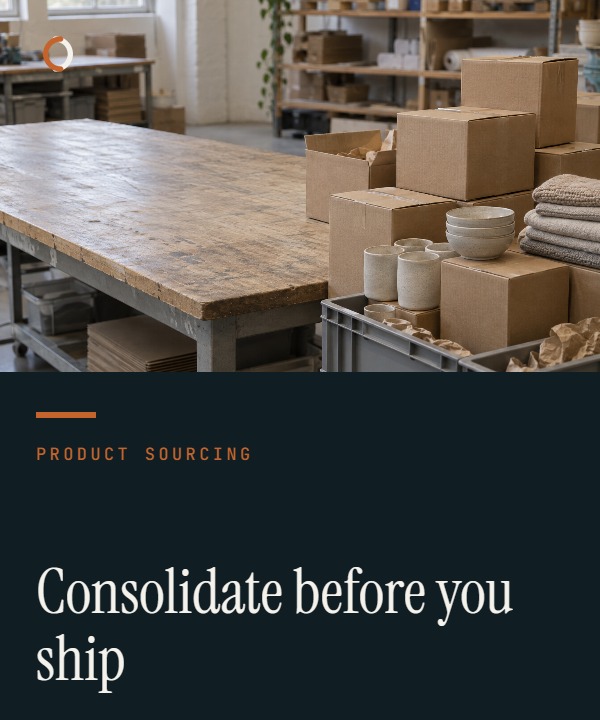
Consolidation is a coordination decision before it is a freight decision
Combining orders from several Chinese suppliers can reduce duplicated handling and create one controlled movement. It can also make every ready supplier wait for the slowest, mix poorly identified cartons and concentrate document errors in one shipment.
Decide from a same-scope plan. Compare separate shipments with a consolidated LCL or FCL option using the same pickup points, Australian endpoint, customs/biosecurity scope, delivery and contingencies. The LCL-versus-FCL guide owns the mode comparison. This article owns the multi-supplier control system.
Do not consolidate until one party owns the origin workflow from supplier follow-up through final release.
Choose the consolidation structure and controller
Common structures include:
- suppliers deliver to a nominated origin warehouse, which receives and combines the cargo;
- a forwarder collects from several supplier addresses and consolidates at its facility; or
- suppliers load directly into one dedicated container under a coordinated plan.
DHL Global Forwarding describes single-country consolidation as combining volumes from multiple suppliers into a dedicated FCL. That shows one recognised service model, not a guarantee that FCL is best for a particular order.
Name the controller in writing. The role should include:
- master supplier and purchase-order list;
- cargo-ready evidence and pickup coordination;
- warehouse receiving and discrepancy reporting;
- package identity and segregation;
- document collection and reconciliation;
- escalation for late or non-compliant cargo; and
- authority to release or hold the combined shipment.
If the importer, sourcing agent and forwarder each assume another party owns these tasks, the workflow has no owner.
Build a supplier readiness board
Use one row per supplier or purchase order:
| Supplier/PO | Ready evidence | Packages and measurements | Compliance flags | Delivery to hub | Exceptions | Release state |
|---|---|---|---|---|---|---|
| A | Inspection passed/date | Cartons, CBM, gross kg | Timber/battery/product | Booked/received | Open/closed | Hold/release |
“Ready” should mean more than a message saying production is finished. Define evidence such as final packing list, packed dimensions/weights, required inspection disposition, package photographs and the agreed commercial documents.
Link the board to the production lead-time plan. Use a cargo cut-off that leaves time for receiving, discrepancy correction and export booking. A supplier that completes production on cut-off day is not necessarily consolidation-ready.
Standardise handover data and package identity
Issue one handover specification to every supplier:
- consolidation reference and purchase-order number;
- warehouse address, contact and receiving window;
- package numbering format, for example
SUPPLIER-PO-001/020; - carton/pallet marks and barcode if used;
- expected pieces, dimensions, net/gross weights and CBM;
- handling, stacking, moisture, battery or dangerous-goods flags;
- packing-list and invoice deadlines; and
- escalation contact for a rejected delivery.
Do not relabel in a way that destroys the connection to the supplier's documents. The origin warehouse may add a consolidation identifier while preserving the factory's package-level reference.
Check packaging against the factory-ready packaging specification, including pallet/crate material and dunnage. Each product still needs its own current BICON and regulatory review; combining cargo does not combine compliance responsibility.
Receive every supplier against evidence
The origin facility should produce a receiving report before cargo is accepted into the released set:
- arrival date and vehicle/waybill reference;
- supplier, PO and package identifiers;
- actual pieces and package count;
- measured dimensions and gross weight where agreed;
- visible condition, water/crush/puncture evidence and photographs;
- missing, extra or unidentified packages;
- damaged or non-compliant packaging; and
- quarantine location for unresolved cargo.
Reconcile measured data with the CBM calculation and freight booking. Do not hide changes inside a final combined total. Keep supplier-level facts available for allocation, claims and document correction.
Control the consolidated document pack
DAFF identifies bills of lading, packing lists, packing declarations, treatment certificates and permits among records that may be relevant to cargo sent to Australia. The exact requirement varies by product and shipment.
Build a manifest that maps each package group to:
- supplier and exporter role;
- commercial invoice and packing list;
- product/SKU and quantity;
- origin or preference evidence where claimed;
- BICON case evidence, permits and treatment records where applicable;
- house/master transport references; and
- the party that packed or observed packing.
For packing declarations, the eligible issuer depends on who packed or observed the consignment. DAFF includes a packer that consolidated LCL consignments among possible issuers. Confirm the applicable packing declaration with the broker; do not make a warehouse attest to supplier packing it never observed.
Set a real go/no-go cut-off
At the cut-off, classify each supplier:
- Release: cargo received, identified, undamaged within tolerance, documents reconciled and compliance flags closed.
- Conditional hold: a correctable discrepancy has an owner and a deadline within the booking window.
- Exclude and ship later: the supplier cannot meet the combined shipment without unacceptable delay or uncertainty.
- Stop the whole consolidation: the unresolved issue affects the container, declaration, booking acceptance or legality of the combined cargo.
Do not let sunk coordination effort force a bad release. Re-quote the options when one supplier misses the gate: wait, exclude, send separately or change mode. Carry the commercial consequence into the decision instead of assuming consolidation must continue.
Compare cost without inventing savings
Build two same-scope scenarios:
separate total = supplier pickups + origin charges + main carriage
               + destination/broker/delivery for each movement

consolidated total = all supplier pickups + consolidation receiving/storage
                   + combined handling/main carriage
                   + destination/broker/delivery
                   + expected delay and exception exposure
Use current written quotes and the freight-quote normalisation guide. Include minimum charges, warehouse receiving, rework, storage, document fees, deconsolidation, delivery and contingencies. Unknown is not zero.
If the combined movement delays saleable inventory, test the margin and stockout consequence. Consolidation is successful when the total workflow is better controlled, not merely when the ocean-freight line is smaller.
Release the physical load with traceability
Before loading, issue an approved release manifest and loading plan. Preserve package identities, weight distribution, moisture protection, segregation and handling instructions. If a container is loaded, use the container-loading check for seal, condition, count and loading evidence.
After arrival, reconcile delivered packages back to the supplier-level manifest. Record shortages or damage against package IDs and receiving/loading evidence rather than one undifferentiated “consolidated shipment”.
Final consolidation checklist
- One controller owns the end-to-end origin process.
- Every supplier uses the same handover and label standard.
- Readiness is evidenced, not self-declared.
- Origin receiving produces counts, measurements, condition and photos.
- Exceptions have owners and deadlines.
- Product, packing and document requirements remain traceable by supplier/SKU.
- The cut-off has explicit release, exclude and stop rules.
- Separate and combined costs use the same scope.
- The final manifest survives loading, clearance and Australian delivery.
Consolidation should reduce fragmentation without erasing evidence. If the combined shipment cannot still be explained package by package, it is not under control.
Sources
Not sure the supplier is real?
We check the factory before you pay: registry and litigation screening, a day on site at each shortlisted factory, and one written recommendation.
See how supplier vetting works →Get the goods checked before you pay the balance.
Our inspectors check production at the factory, mid-run and before shipment. They're paid by you, not the factory, so they work for you.
See quality control →Shipping from China to Australia?
We consolidate orders from several suppliers at our Guangzhou warehouse and coordinate the move with licensed forwarders, with one point of contact from factory to your warehouse.
See freight services →Need a factory that can make it?
We find and vet suppliers, including capable smaller factories that are more flexible on MOQ and terms, negotiate in Mandarin, and get samples to your desk before anything is committed.
See product sourcing →


