


“We thought we had a proper factory — until we got cartons of dirty cans and bottles. Quality inconsistency is a massive problem for us”
— Raj Rai, Director Charge .
This kind of story is all too common. Sourcing from China (or any overseas market) offers huge opportunity, but also nontrivial risk. The difference between a smooth order and a disaster often comes down to how well you verify suppliers—not just whether they look good on Alibaba, but whether they’re truly capable, trustworthy, and aligned with your quality standards.
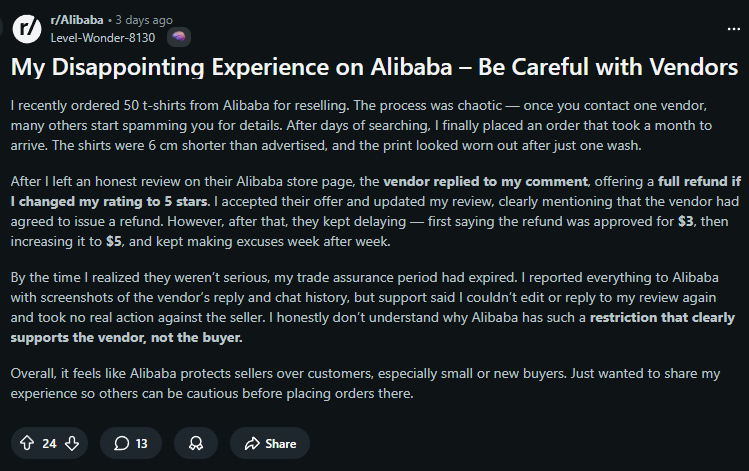
Too many new importers treat Alibaba like a magic portal: click, order, done. In reality, success lies in careful vetting, layered verification, and risk management.
What does “Verified Supplier” mean on Alibaba?
A Verified Supplier badge means the supplier has paid for an assessment in which an independent inspection company (such as SGS, TÜV or Intertek) checked its legal registration, premises and declared capabilities at a point in time. It is a useful filter. It is not proof that the supplier is a factory rather than a trading company, that it can make your product to your specification, or that quality will hold from one production run to the next. Alibaba itself does not guarantee the authenticity or quality of what is listed.
The three labels buyers most often confuse:
- Verified Supplier: a third-party assessment of the business at a point in time. The strongest of the three, but still a snapshot.
- Gold Supplier: a paid membership. On its own it says very little about the factory.
- Trade Assurance: order protection, not supplier verification. It gives you a dispute route when an order paid through Alibaba ships late or doesn’t match the agreed terms, and it only covers orders placed and paid on the platform.
Treat any badge as the start of your checks, not the end. The rest of this guide covers what to check next.
1. Why “Verified” Badges Only Get You So Far
Badges are comforting. Alibaba’s Verified Supplier, Gold Supplier, and Trade Assurance tags give you a quick filter. But they’re far from foolproof, Alibaba’s Verification Services include checks by independent third parties (SGS, TÜV, Intertek) across a supplier’s legal status, factory operations, and declared capabilities. (activities.alibaba.com)
But:
- Audits may be superficial or snapshot-based; factories can rent space, borrow machines for audits, or hide real operations.
- Alibaba itself notes: it does not guarantee the authenticity or quality of any product listed. (activities.alibaba.com)
- Many “Gold Supplier” badges are simply paid memberships with minimal verification. The “Verified Supplier” badge is more rigorous — but even that is a snapshot inspection, not a guarantee of long-term performance. (verifysupplier.org)
It’s worth noting that membership in the Verified Supplier program can cost suppliers roughly USD $12,500 per year — which means some may pursue it for the visibility, not because their factory is world-class.
Your work starts after you filter down, you need a multi-layered verification approach: start with digital signals and platform badges, then dig deeper with document checks, live inspection, reference validation, and third-party audit
2. How to Filter & Pre-Screen Suppliers on Alibaba (Smart Triage)
| Step | What to Do | Why It Helps |
|---|---|---|
| Apply filters | Tick “Verified Supplier PRO”, “Trade Assurance” | Narrows out the most obvious red-flag suppliers |
| Use search modifiers | Add terms: factory, manufacturer, OEM, ISO 9001 | Surfaces suppliers managing core manufacturing rather than trading resellers |
| View profile stats | Look at “Years in Business”, “Export %”, “Main Markets” | Longevity, export experience, and customer geography are signals |
| Request documentation | Ask for business license, export permit, tax registration, product certifications | Allows you to cross-check with Chinese registries |
| Check certificate authenticity | Verify the certification numbers (CE, RoHS, etc.) via the issuing body | Many certificates are forged or recycled |
| Request sample + evidence | Ask for a functional sample, factory photos/videos, QC report | Helps you compare the sample against specs, and peek behind the curtain |
💡 When a supplier shares a document, check if the registered Chinese name (in characters) matches what they claim in their Alibaba profile. Many fraudulent suppliers borrow or fake documentation with mismatched names.
2.1 Use the right filters & search techniques
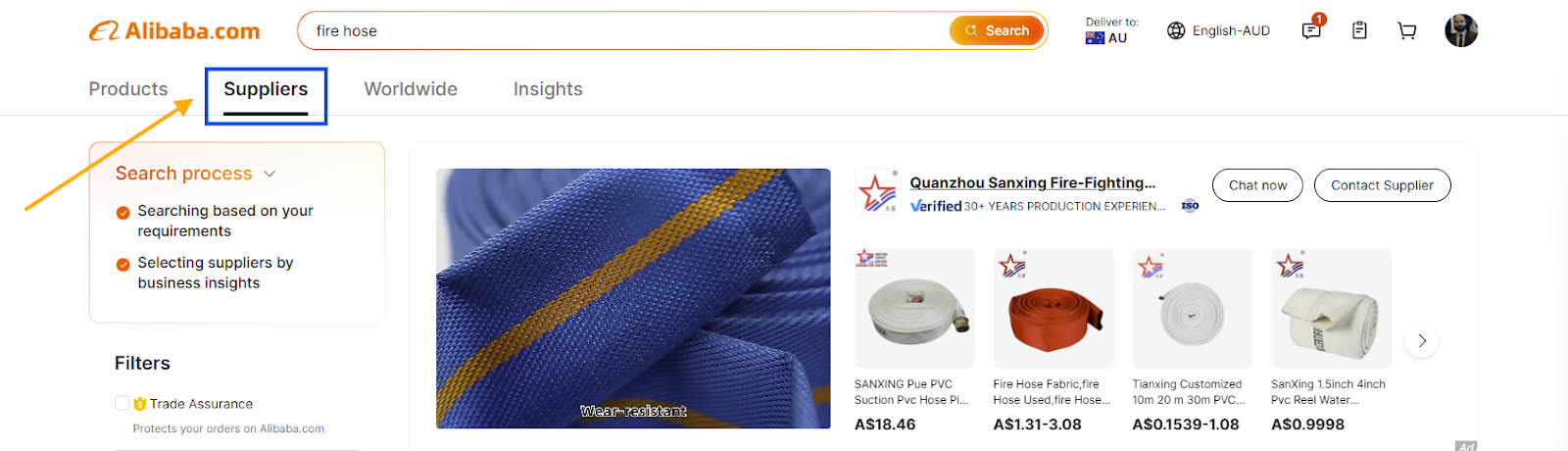
- Make sure you are searching in the supplier directory and not just the product directory
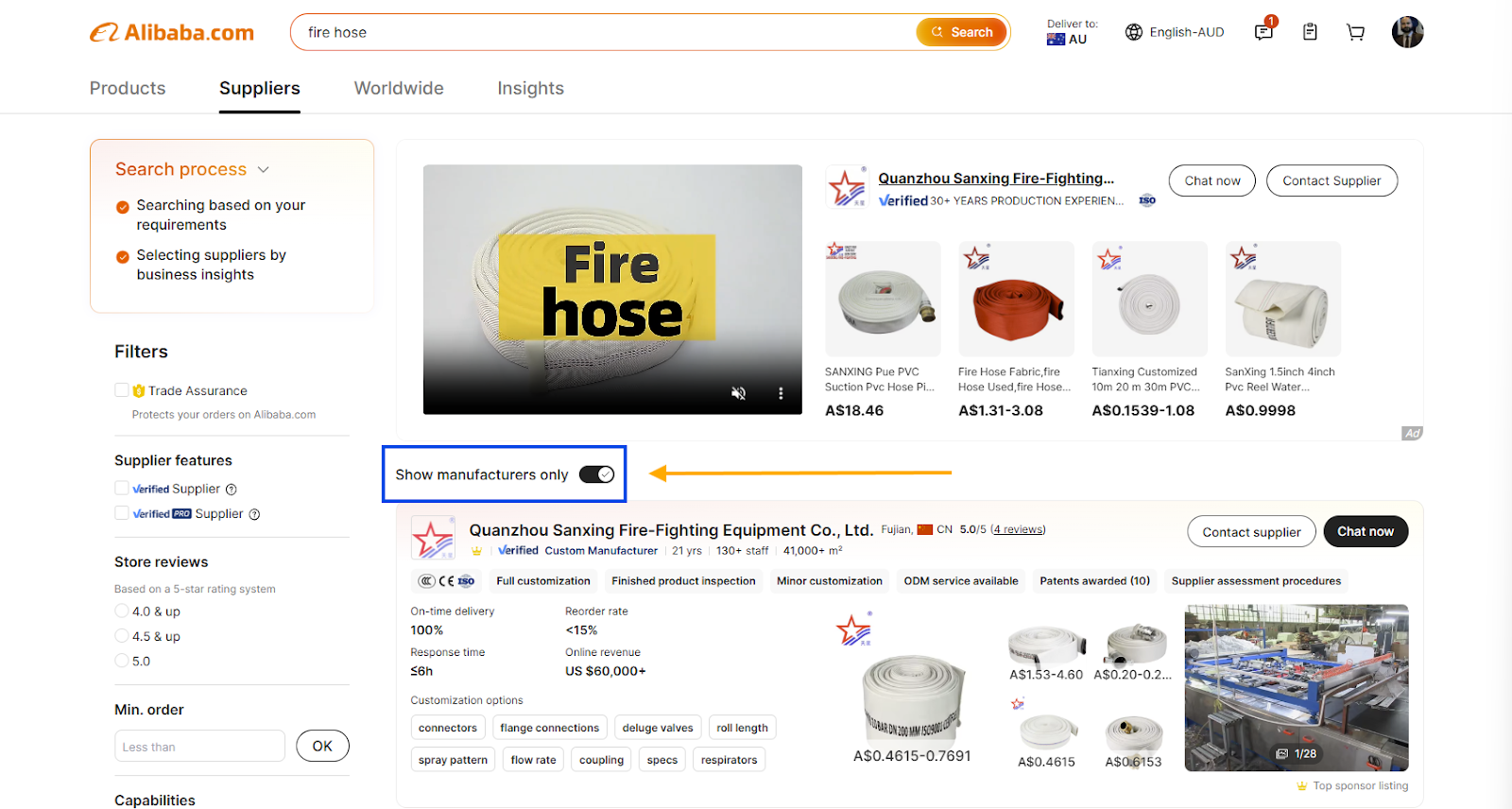
- Tick “Verified Supplier PRO”, this shows only suppliers with a minimum of 5 years industry presence. It is not the same as “Time on Alibaba”, which is a separate filter on it own
We also recommend “Trade Assurance”, filters to narrow results.

- Use keyword modifiers like “factory”, “OEM”, “ISO 9001” in your product search. We recommend mostly using a quality certification in searches as it helps to pinpoint factories that follow rigorous quality procedures.
Quality problems usually trace back to weak process control, not just bad materials, which is why a certification that audits the process is a useful filter.
If you look at the example below:
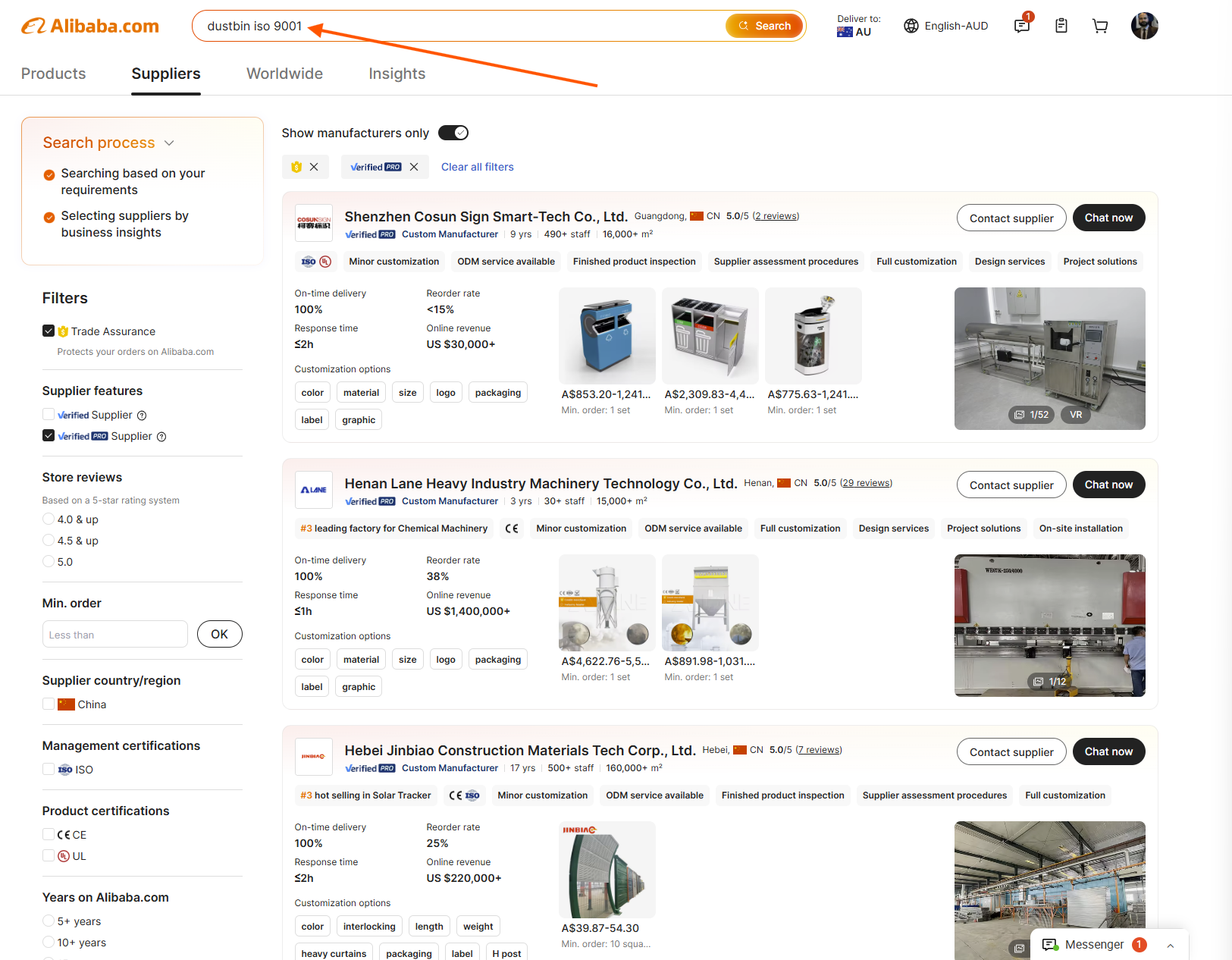
Let’s click on the first factory in the results:
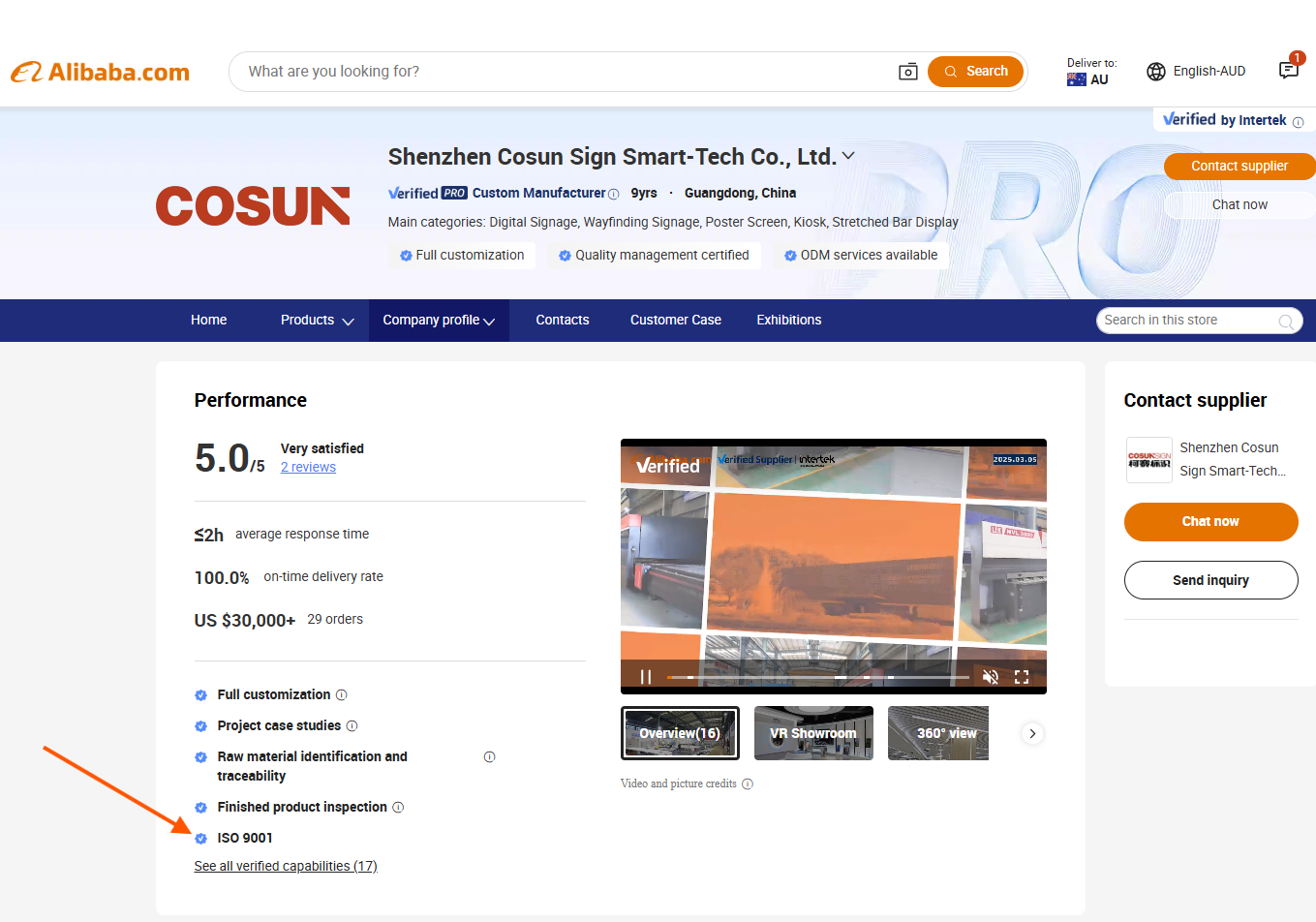
You can see that the factory does indeed hold an ISO9001 certification. Obviously, you will still ask them to show you the certificate (and verify) but this is a great filtration point. Be very mindful of the words you put in that search box!
- You can also sort by “Transaction Level” to surface suppliers with higher sales volume or buyer activity.
- Check “Main Markets,” “Export Percentage,” and “Years in Business” stats. This is obviously subjective and dependent on your target market but, generally, the factories that are producing for the EU have to uphold high quality standards to meet their clients compliance demands.
💡Red flags:
- The listing claims “factory” but the company name or address is residential or a small office building
- Zero or very low exports even though they claim “main markets” abroad
- Contradictions between listing data (e.g. a “factory” that lists only a few product SKUs or no heavy machinery photos)
2.2 Scrutinize the company profile & request documents
- Ask the supplier to send a business license, tax registration certificate, export license (if applicable).
- Check whether the name (in Chinese) on the license matches what’s on Alibaba.
- Use China’s National Enterprise Credit Information Publicity System (NECIPS) or equivalent regional registries to verify registration and status.Check that the business scope on the license includes the product type they claim to make (i.e. they are legally allowed to manufacture your product) SVI Global Ltd. Supplier verification guide
- Ask for relevant product certifications (CE, RoHS, FCC, etc.) and ask for their registration number (so you can verify with the certifying body).
💡Red flags:
- The supplier delays or refuses to send scanned copies of licenses or only sends images that are blurry or edited
- The Chinese name / address / legal representative name on the documents differs from their Alibaba profile
- The business scope doesn’t include manufacturing or export/import operations
- Certification number does not show up when you check the issuing database
- The license is very recent (e.g. less than 1 year) for a company claiming large capacity
2.3 Factory checks, not just samples
Order a sample — but don’t stop there. Also request:
- Photos or video walkthroughs of their production floor. Visual evidence gives you indirect insight into factory capacity, machine types, workflow
- Production line or workshop images
- Past product QC reports to show whether the supplier has had formal inspections — and whether they passed or failed.
- Check consistency across platforms — search the same company name on other B2B sites (Global Sources, Made-in-China and trade fair sites). If their details (address, contact, product range) line up, that’s confidence-building.
- Compare how sample units perform against your full spec (materials, tolerances, finishing).
💡Red flags:
- The sample is of much better quality than what the photos show of the production workshop (i.e. sample was “dressed up”)
- Videos or photos are stock or clearly staged (same angles, poor lighting, no depth)
- Supplier is unwilling or reluctant to produce test reports or refuses to show raw materials
- The sample does not include key metrics you asked for (e.g. thickness, strength, tolerances)
2.4 Leverage Alibaba’s “Assessed Supplier / Verification Services”
Alibaba offers an Assessed Supplier service: they commission third-party agencies to audit supplier operations and publish a report (including factory inspection, capacity, management). Alibaba Reads
Look at what the audit actually covered — if it’s just front-office or showrooms, that’s weak. Focus on whether they inspected core production lines, raw material storage, QC labs, etc.
2.5 Test communication & ask tough questions
- Test their communication flow and proficiency. This sounds simple but is one of the key building blocks of a good supplier relation and ultimately a smooth supply chain. I am not just talking about their language efficiency, I am talking about their willingness to ask questions, the depth of their responses, their speed of response and an effort to understand your product and your business.
- Bigger factories will often have low level employees handling Alibaba queries, if your query is important enough it can be escalated to senior and more knowledgeable people in the company.
- Ask for reference clients or orders in your region and contact them (if possible) to verify experience.
3. Asking Tough Questions & Live Walkthroughs
Filtering gets you down to a shortlist. Now it’s time to dig deeper.
- Ask technical, process questions — e.g. “Which injection molding machine brands do you use? What is your shrinkage tolerance for this polymer?”
- Request a live video factory tour — ask them to pan slowly across raw materials, machines, workstations. If they hesitate or freeze the camera, that’s a red flag.
💡Few factories hold quality steady on their own. Most fluctuate with order volume, cost pressure and management changes, which is why verification has to continue after the first order.
4. Beyond Alibaba: Diversify Your Supplier Sources
Relying solely on Alibaba is risky. Here are alternatives you should weave into your sourcing strategy:
4.1 Global Sources, Made-in-China, 1688
- Global Sources applies stricter vetting and financial audits than many Alibaba listings.
- Made-in-China.com often features more factory-direct listings.
- 1688.com is the Chinese domestic B2B marketplace. It often includes factories that don't list globally—but you’ll need a Chinese agent or translator to navigate it.
4.2 Trade shows & fairs
- Shows like Canton Fair, Global Sources Fair, regional expos in Yiwu or Shenzhen let you meet in person, inspect sample production, and test cultural fit.
- Being able to walk the factory floor reveals things that audits or videos won’t show (raw material storage, workflow, cleanliness).
4.3 Sourcing agents & third-party auditors
- Use local sourcing agents to visit factories, negotiate, and act as your eyes on the ground. A sourcing agent (right one) can be your eyes and ears in China. They know the people, the market and are equipped to deal with the Chinese industry much better than any foreigners. If you are weighing that up, here is how to choose a China sourcing agent in Australia, and how using an agent compares with buying direct on Alibaba once landed cost is included.
- Already have a supplier in mind? Our supplier vetting service runs these checks for you: registry, litigation and trade-data screening, then a day on site at each shortlisted factory, with documents sighted in the original and one written recommendation.
- Engage audit firms (SGS, Intertek, Bureau Veritas) Engage a third-party audit / inspection firm to perform:
- Factory audit (pre-contract) assessing capability, compliance, social factors
- During-production inspections (DPI) to catch issues mid-manufacture
- Pre-shipment inspections (PSI) to ensure finished goods meet your specs. Pro QC
- Mystery inspections — unannounced visits during production — often expose what scheduled audits miss.
4.4 Factory visits or local inspections
- When possible, visit yourself.
- If you can’t travel, hire a trusted sourcing agent or sourcing agency. You can also use “mystery shopper” services.
5. Ongoing Verification: Systems & Safeguards
Even a good first order can go bad if you don’t sustain oversight. Here’s how to build control systems:
- In-line and pre-shipment inspections — set quality checkpoints during production, not just at the end.
- Random sampling tests for critical parameters (dimensions, performance, durability)
- Use statistical sampling methodology (e.g. AQL) rather than eyeballing everything
- Require QC reports with photos for each lot stage. Skip independent QC and you find the defects in Australia, after the balance is paid, instead of at the factory while they are still the supplier’s to fix.
- Small batch scaling — don’t jump to huge orders. Use trial lots and scale gradually.
- Milestones & payment staging — link payments to performance/QC outcomes.
- Contractual protections — include penalty clauses, holdbacks, mandatory third-party inspection, and clear definitions of acceptable tolerances and defects.
- Performance scorecards — track metrics: defect rate, delivery adherence, communication speed.
- Annual re-verification & audits — require suppliers to update licenses, financials, insurance, and allow spot audits.
6. Common Myths & Pitfalls (Watch Out)
- “Verified Supplier = Factory” — No. Many are trading firms. Being Verified is often about visibility, not production. (jingsourcing)
- Over-reliance on Alibaba’s dispute system — Alibaba’s support is helpful but limited. Many disputes drag on.
- Chasing ultra-low price — If the quote is too good to be true, quality or compliance may be sacrificed.
- Neglecting regulatory compliance — Products without certifications or legal compliance (e.g. safety, import law) will cost you in penalties or blocked shipments.
- Ignoring cultural and communication gaps — Always confirm critical agreements in writing, and double-check key terms like lead time, material, MOQ, and packaging.
Earning reliable supplier relationships is a marathon, not a sprint. You won’t figure everything out before your first order — but with a structured verification process, diversification, and ongoing oversight, you can progressively reduce risk.
Your action plan:
- Apply strict filters + document requests
- Ask live walkthroughs and technical questions
- Use alternative sourcing channels (fairs, agents, platforms)
- Put systems in place (QC, contract, scorecards)
- Monitor, audit, and re-verify continuously
What to do next
If you are about to pay a deposit to a supplier you have only met on Alibaba, get it checked by someone on the ground first. Once the money has gone, your leverage goes with it. Send us the listing or the supplier’s details and our supplier vetting team will tell you what is actually behind it.
One more thing the badge hides: some of the best suppliers for smaller orders don’t pay for Verified status at all. Smaller factories are often more flexible on price, order quantity and payment terms than the big Verified names. They need closer checking and closer management, and that is exactly the work we do at Ocean Port Link.
Related China sourcing guides
- Supplier vetting: get a factory checked before you pay
- How to choose a China sourcing agent in Australia
- Sourcing agent vs buying direct on Alibaba
- Explore China’s manufacturing cities
- Australian import regulations for new importers
- Incoterms for Australian importers sourcing from China
- Australian ecommerce trends and sourcing implications
Not sure the supplier is real?
We check the factory before you pay: registry and litigation screening, a day on site at each shortlisted factory, and one written recommendation.
See how supplier vetting works →Get the goods checked before you pay the balance.
Our inspectors check production at the factory, mid-run and before shipment. They're paid by you, not the factory, so they work for you.
See quality control →Shipping from China to Australia?
We consolidate orders from several suppliers at our Guangzhou warehouse and coordinate the move with licensed forwarders, with one point of contact from factory to your warehouse.
See freight services →Need a factory that can make it?
We find and vet suppliers, including capable smaller factories that are more flexible on MOQ and terms, negotiate in Mandarin, and get samples to your desk before anything is committed.
See product sourcing →


