

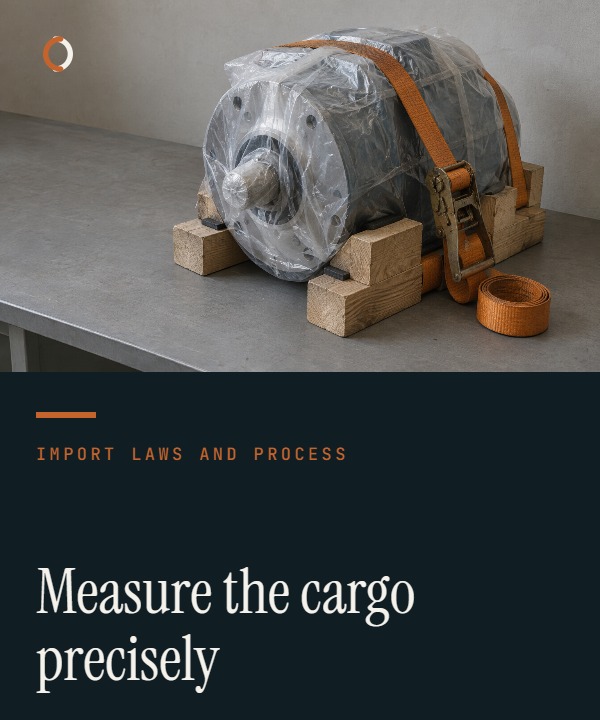
Out-of-gauge cargo planning should start with one controlled cargo record for every piece—not with a guess about a 20-foot or 40-foot flat rack. Record the final shipping envelope, gross packed weight, drawings, photographs and handling facts; label every provisional value; then ask the carrier, forwarder and qualified specialists to confirm the equipment, engineering and route.
That distinction matters. A quotation pack supplies evidence for an assessment. It does not approve the lifting points, lashing, weight distribution, payload, road movement, terminal handling or carrier acceptance. A price is not a booking, and a booking is not an engineering certificate.
Build the evidence pack before asking for an equipment answer
A useful first enquiry lets a specialist see what is known, what is still provisional and which part of the journey is being priced. It also gives the importer a stable record against which to read the quotation back.
Carrier requirements show why a product-page description is not enough. Maersk's special-cargo quote workflow asks for origin, destination, shipment type, equipment request, weight, dimensions, commodity information and a photograph. Hapag-Lloyd also asks for packaging, drawings and the number and location of lifting and lashing points. These are assessment inputs—not an invitation for the importer to design a lift or declare the points adequate.
Start with an enquiry ID and revision number. Keep the supplier's evidence, specialist questions and returned quotation attached to that version. When packing, a skid, a cradle, dunnage or securing changes the envelope or weight, issue a new revision instead of silently overwriting the earlier number.
Start with one cargo record for every piece
Do not combine unlike pieces into one line such as “one machine set”. Each transport piece needs a record. If two pieces have the same catalogue model but different packing, dimensions or weights, they are two records.
Describe the transport configuration, not the catalogue product
A catalogue may describe the bare machine. The carrier has to assess the item it will receive: packed, mounted, protected and presented for transport. Give every piece a stable identifier that appears on the drawing and photographs.
| Field | What to record | Evidence | What remains held |
|---|---|---|---|
| Identity | Enquiry ID, piece ID, commodity/model and quantity | Purchase specification or packing record | Classification and dangerous-goods acceptance if relevant |
| Final configuration | Case, skid, cradle, wrapping, projections and orientation | Dated packing drawing and photographs | Packaging or structural adequacy |
| Envelope | Overall length, width and height at the furthest points | Dated measurement sheet and dimensioned drawing | Equipment fit and carrier tolerance |
| Mass | Gross packed weight for that piece | Scale record, manufacturer document or identified supplier statement | Payload, axle, point-load and distribution approval |
| Centre of gravity | Competent-source location and datum, if available | Manufacturer or qualified specialist document | Any inferred CoG or stability conclusion |
| Handling features | Factual position/identity of marked lifting and lashing points; orientation restrictions | Manufacturer drawing or specialist-issued plan | Point adequacy, lift method and securing design |
| Journey | Exact origin, destination, handover points, ready date and requested scope | Enquiry instruction | Road, terminal, vessel and permit feasibility |
Separate confirmed measurements from provisional values
Add an evidence-status column rather than letting estimates look final:
- Measured: taken from the final shipping configuration, with date and method recorded.
- Supplier-stated: provided by the supplier, with its source document identified.
- Manufacturer-issued: copied from an identified manufacturer drawing or data sheet.
- Specialist-issued: supplied by a named competent engineer, surveyor or other relevant specialist.
- Provisional: an estimate awaiting packing, weighing, measurement or specialist confirmation.
These are internal control labels, not carrier approval statuses. A value can be accurately copied from a supplier document and still require carrier confirmation. Never relabel an estimate as measured simply because a quotation used it.
Measure the final shipping envelope
Record overall length, width and height at the furthest points of the transport piece. State the measurement datum and orientation so another person can understand which end or side produced each value. The envelope may include a skid, cradle, case, protective frame, dunnage or a securing component—not only the product itself.
Maersk warns that packaging, lashing and dunnage can change declared dimensions, and that a discrepancy can lead to refusal or shutout. That is why the workflow needs both an early estimate and a final remeasurement. If the lashing arrangement is not yet designed, mark the affected envelope as provisional and ask what allowance the specialist needs; do not invent one.
Provide a dimensioned drawing plus dated photographs from several sides. A tape or scale visible in a photograph can help a reviewer understand the object, but it is not a substitute for a controlled measurement record. Make sure the same piece ID and revision appear on the drawing, measurement sheet and photo list.
Do not convert overall dimensions into a flat-rack recommendation yourself. Published fleet tables are useful reference material, but carriers warn that equipment can vary by series or unit. The specialist must confirm the actual equipment assumptions and the unit or fleet limits used.
For ordinary container planning, use OPL's shipping container sizes guide. Its standard-equipment screening is a different job from OOG acceptance.
Record weight and centre of gravity without inventing either
Ask for the gross packed weight of each piece, not the net product weight. Identify whether the value came from a scale record, a manufacturer document or a supplier statement, and record its date. Where packing, bedding, dunnage or securing material forms part of the presented load, make clear whether it is included.
Do not treat the payload printed on an equipment specification as an approval. Hapag-Lloyd's general guidance explains that permissible weight can depend on resting length and load distribution; carrier technical teams verify a specific load. ONE similarly cautions that its published container specifications are examples and actual equipment can differ.
Centre of gravity needs the same discipline. If a manufacturer or qualified specialist provides it, record the location, axes, datum, source and revision. If no reliable value exists, say so. Do not substitute the geometric centre or a visual guess, and do not use a supplied coordinate to declare the load stable.
Weight and dimensional data may still be useful for volume and commercial comparisons. If you need the underlying arithmetic, see how to calculate CBM. CBM does not answer payload, point-load, overhang or special-equipment acceptance.
Add the handling facts specialists need
Your record should identify the commodity, packaging and any manufacturer instructions about orientation, weather protection or handling. Show the factual location and marking of lifting and lashing points in drawings and photographs. If an item must remain upright or cannot bear top loading, cite the source of that restriction.
Then stop at the factual boundary. A marked eye or lug is not proof that it is adequate for the proposed lift or securing arrangement. The quotation pack must not select a crane, sling, spreader, lashing capacity, angle or quantity. It must not approve bedding, bracing or pressure points. Route those questions to the qualified party named for the movement, and retain their issued document with the same cargo revision.
If the cargo might be dangerous goods, do not infer its status from the product name or appearance. Pause that conclusion and obtain the required classification and carrier acceptance through the appropriate specialist process.
Define the journey being quoted
“China to Australia” is not a quotable special-cargo scope. State the actual collection address, export gateway, requested Australian gateway, delivery address or agreed handover point, cargo-ready date and requested service scope. Identify the agreed Incoterm and named place; OPL's Incoterms guide for Australian importers explains why the named place matters.
Also record observable access facts without deciding feasibility: site opening hours, gate or road restrictions reported by the site, available loading area, who controls loading and unloading, and whether the delivery point expects the cargo on equipment or stripped elsewhere. Photographs or a site sketch can clarify the question.
Ask the forwarder to identify what its scope assumes at each handover. An ocean flat-rack solution does not by itself settle inland haulage, road permits, terminal handling, lifting or delivery access. Those decisions remain with the relevant carrier, terminal, transport provider, authority and qualified specialist.
Issue a versioned quotation pack
A small change can invalidate an earlier assessment. Put the enquiry ID, revision, issue date, prepared-by name and status on every sheet. Include a change log that says which pieces and fields changed.
- Issue Revision 0 — preliminary with every estimate visibly marked.
- Collect carrier, forwarder and specialist questions against that revision.
- Complete the packing, lifting and securing designs through the responsible qualified parties.
- Remeasure and reweigh the final shipping configuration; issue Revision 1 — final evidence for confirmation.
- Ask each quote provider to restate the data and assumptions it priced.
- Obtain the required carrier, terminal, survey, engineering and route approvals separately.
- Confirm that the booking record uses the final cargo revision.
If any dimension, weight, packaging, CoG, lifting point, lashing point, route or handling instruction changes, reopen the affected assessments. Do not assume that a commercial quote automatically rolls forward.
Read every special-cargo quote back against the same fields
Comparing only the bottom-line price can hide different cargo revisions and service scopes. Use one read-back table for every quote:
| Read-back field | What the quote should make clear | Importer action if absent |
|---|---|---|
| Cargo identity | Enquiry ID, revision, commodity, piece count | Ask which record was priced |
| Dimensions | L/W/H and any directional overhang used | Reconcile to the final measurement sheet |
| Weight | Gross weight per piece and total used | Reconcile source and inclusion of packing/dunnage |
| Equipment assumption | Type, size, end-wall or other configuration assumed | Ask the carrier/forwarder to state it; do not self-approve |
| Route and scope | Origin, gateway, destination, handovers and included services | Mark exclusions and owner for each gap |
| Specialist work | Who supplies packing, lashing, lifting, survey and engineering documents | Assign each responsibility by name |
| Approval state | Quoted, subject to review, approved, booked or accepted | Do not collapse the states |
| Commercial controls | Validity, currency, surcharges, exclusions and change rule | Compare on the same scope and revision |
Use OPL's freight quote line-items guide to normalise the broader commercial scope. EVG-069 adds the cargo-revision and specialist-approval layer needed for OOG enquiries.
Stop at the specialist boundary
Hold and escalate any conclusion about:
- lashing or securing design, capacity, angle, quantity or certification;
- lifting method, crane or sling selection, rigging or lifting-point adequacy;
- centre of gravity, stability, bedding, point loads, weight distribution or structural suitability;
- equipment payload or fitness, road legality, permits, bridge or route feasibility;
- terminal, vessel, authority, surveyor or carrier acceptance; and
- dangerous-goods classification or acceptance.
Carrier guides are general. Maersk and Hapag-Lloyd both make clear that securing remains cargo-specific and that unsafe arrangements may be refused. Use their guidance to frame the questions; use the responsible specialist's issued work and the carrier's confirmation for the answer.
Use this quotation-pack checklist
Before sending an enquiry
- Give the enquiry and every piece a stable ID.
- Record the final transport configuration, not only the catalogue product.
- State L/W/H at the furthest points, the datum, units, source and date.
- State gross packed weight per piece, source, date and inclusions.
- Attach aligned drawings and photographs with IDs and revisions.
- Record supplied CoG and handling-point facts without validating them.
- Label every value measured, supplier-stated, manufacturer-issued, specialist-issued or provisional.
- Define the exact origin, destination, handovers, ready date, named Incoterm place and requested scope.
- List every engineering, handling, route, permit, terminal and carrier question still open.
Before accepting a commercial quote for further approval
- Confirm which cargo revision and piece count were priced.
- Read back dimensions, directional overhang and weights.
- Record the equipment, route and handover assumptions.
- Assign packing, lashing, lifting, survey and engineering responsibilities.
- Separate quoted, subject-to-review, approved, booked and accepted states.
- Remeasure after final packing/securing design and reopen any changed assessment.
Sources
- Maersk — Out of Gauge Cargo
- Maersk — Special Cargo
- Maersk — How can I request a special-cargo quote?
- Hapag-Lloyd — Special Cargo
- Hapag-Lloyd — Special Cargo Loading and Lashing
- Ocean Network Express — Special Cargo Handbook 2025
- MSC — Project Cargo
- CMA CGM — Booking guidelines: mandatory requirements
Not sure the supplier is real?
We check the factory before you pay: registry and litigation screening, a day on site at each shortlisted factory, and one written recommendation.
See how supplier vetting works →Get the goods checked before you pay the balance.
Our inspectors check production at the factory, mid-run and before shipment. They're paid by you, not the factory, so they work for you.
See quality control →Shipping from China to Australia?
We consolidate orders from several suppliers at our Guangzhou warehouse and coordinate the move with licensed forwarders, with one point of contact from factory to your warehouse.
See freight services →Need a factory that can make it?
We find and vet suppliers, including capable smaller factories that are more flexible on MOQ and terms, negotiate in Mandarin, and get samples to your desk before anything is committed.
See product sourcing →


