

Before you accept a landed-cost estimate, run two separate anti-dumping checks. First, search the live Dumping Commodity Register for measures already in force. Second, search current cases and the Electronic Public Record for investigations, reviews, continuations, exemptions or anti-circumvention activity that may change the position.
Do not stop at a tariff code. Record the exact goods description, country of export, manufacturer, exporter or trader, planned export date and the official files you reviewed. Then give that evidence to a licensed customs or anti-dumping specialist before you decide whether a measure applies or what amount to declare.
Australian Border Force says dumping and countervailing duties are additional to ordinary customs duty and indirect taxes, and they can be substantial. They may still apply when an ordinary customs-duty preference is available under a free trade agreement (ABF: Dumping and countervailing duties). That is why a missed screen can invalidate the commercial model even when the supplier quote and base freight are correct.
Start with the facts, not a code search
Prepare one product-and-supply-path record before opening the register:
- the goods as imported, including dimensions, material, grade, finish, components and intended function;
- drawings, photographs, specifications and model identifiers;
- the proposed Australian tariff classification and the evidence behind it;
- country of export and, where relevant, country of origin;
- the actual manufacturer and every exporter, trader or invoicing entity;
- the planned export date and shipment documents that will later prove it;
- Incoterm, invoice path and supplier declarations; and
- any product modification, assembly or routing that could change the official description match.
The Australian classification is a useful search lead, but it is not a product-scope ruling for anti-dumping purposes. The DCR's tariff classifications are reference aids rather than conclusive scope boundaries. Preserve the physical and commercial facts so the specialist can test the official goods description rather than reverse-engineering the product from an invoice label.
Pass 1: search current measures in the DCR
Open the Anti-Dumping Commission's current Dumping Commodity Register. Search the commodity, country and candidate classification, then open the linked commodity PDF rather than relying on the result line alone.
Record the exact file and retrieval date. The register is dynamic: measures, reviews, exporter treatment and linked cases can change after an old quote or spreadsheet was prepared.
| Screening field | What to preserve | Why it matters |
|---|---|---|
| Commodity entry | Exact title, country and DCR update date | Proves which current register entry was reviewed |
| Goods description | Full included and excluded wording | Scope turns on the described goods, not a shorthand label |
| Tariff references | Codes listed plus your classification record | Codes support searching but do not settle product scope |
| Manufacturer/exporter path | Legal names and roles supported by invoices and supplier records | Exporter treatment may be specific; a trader name is not automatically the manufacturer |
| Duty/case references | Linked notice, DSN or current case identifier | Enables qualified review without inventing a public rate |
| Export-date rule | Planned date and later transport evidence | The applicable position can depend on when the goods were exported |
Read the goods description before the tariff table
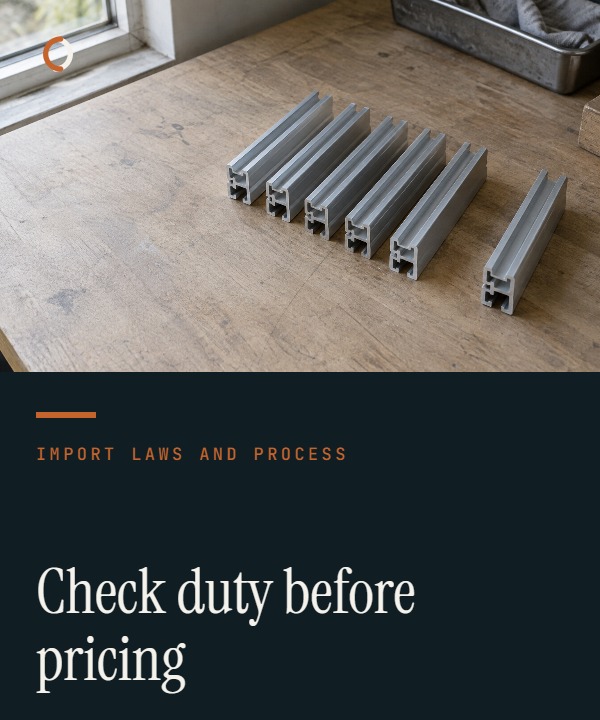
The current aluminium-extrusions DCR illustrates the control: the official document gives a detailed goods description and cautions that tariff classifications are provided for reference (Anti-Dumping Commission: Aluminium Extrusions DCR). Use that document only as an anatomy lesson. Do not assume its inclusions, exclusions or classifications apply to another commodity.
When the physical product sits near a boundary—such as a further-worked component, kit, composite article, part, accessory, grade or dimension threshold—stop. Product-specific scope is a specialist conclusion, not a reasonable keyword guess.
Identify the supplier path without guessing the duty
A commercial chain can involve a factory, export company, trader, purchasing agent and DDP provider. Capture each legal name and its role. Ask for manufacturer evidence, exporter identity and the documents that will support the Australian declaration.
Do not choose an exporter treatment or duty notice based on a similar English name. Do not treat a supplier's assurance that “the duty is included” as scope evidence. Some inputs may be confidential or require contact with the Anti-Dumping Commission; the licensed broker or specialist should resolve the applicable declaration method.
Pass 2: check current cases and the EPR
After the DCR screen, open the Commission's current cases and Electronic Public Record. Review every linked matter relevant to the commodity and country.
Status language matters. An investigation, review, continuation inquiry, exemption inquiry or anti-circumvention inquiry is not automatically a final duty result. Record:
- case number and process type;
- goods and country stated in the case;
- applicant and named exporters where published;
- current milestone and official date;
- preliminary or final notices actually issued;
- any securities direction described in the official record; and
- the next date when the screen must be refreshed.
Do not predict the decision. The useful commercial action is to expose the uncertainty before a deposit or sales commitment, then ask the specialist how the current status should enter the risk range.
Preserve the export-date evidence
ABF guidance explains that goods exported before a duty notice but entered later use the rate applicable at export, with evidence of the export date required. Describe this as an export-date rule, not as a slogan about “retrospective” duty.
Before shipment, keep the transport booking, bill of lading or air waybill, commercial invoice, export declaration where available, cargo-received evidence and dated supplier correspondence. Ask the broker which document will be relied on and whether the planned schedule creates any timing issue.
Re-run both passes shortly before export. A screen performed when the purchase order was signed is not proof of the current position months later.
Build the specialist handoff pack
| Evidence group | Minimum handoff |
|---|---|
| Product identity | Specification, drawings, photographs, material/grade, dimensions, function and model |
| Classification | Proposed Australian classification and rationale; unresolved alternatives clearly marked |
| Supply path | Manufacturer, exporter, trader and invoice relationships with legal names |
| Official screen | DCR PDF and update date; current-case/EPR links and status snapshot |
| Commercial record | Quote, purchase order, Incoterm, price basis and any DDP representation |
| Timing | Planned export date and later proof of export |
| Decision | Named specialist, advice date, assumptions, recheck date and booking/deposit hold owner |
Label unresolved items as unresolved. A blank exporter, unverified manufacturer or missing goods specification is not a zero-risk result.
ChAFTA and DDP do not remove this check
A ChAFTA preference concerns ordinary customs duty for qualifying originating goods; it does not switch off Australian dumping or countervailing measures. Keep the origin evidence separate from the anti-dumping screen and link the two in the import file.
Similarly, a DDP term allocates delivery and import-clearance obligations under the contract; it does not prove that the declaration, value, scope decision or duty treatment is correct. The existing OceanPortLink guide explains the narrower question of whether DDP covers anti-dumping duty in Australia. This article's job is to make the measure visible before you rely on any DDP total.
For product-specific context, see the existing guides on aluminium extrusion anti-dumping risk and Chinese hollow structural sections. Use their official case links as examples of current evidence, not as templates for unrelated goods.
The decision rule
Do not authorise the deposit, landed-price promise or shipment while the goods description, country, manufacturer/exporter path, current DCR status, relevant case status or export-date evidence remains unresolved.
The safe output of this screen is not a percentage. It is a dated evidence pack and a qualified decision: no relevant record found on the stated facts, possible exposure requiring further work, or measure/case identified for specialist declaration advice. Preserve the assumptions and recheck date with the commercial model.
Not sure the supplier is real?
We check the factory before you pay: registry and litigation screening, a day on site at each shortlisted factory, and one written recommendation.
See how supplier vetting works →Get the goods checked before you pay the balance.
Our inspectors check production at the factory, mid-run and before shipment. They're paid by you, not the factory, so they work for you.
See quality control →Shipping from China to Australia?
We consolidate orders from several suppliers at our Guangzhou warehouse and coordinate the move with licensed forwarders, with one point of contact from factory to your warehouse.
See freight services →Need a factory that can make it?
We find and vet suppliers, including capable smaller factories that are more flexible on MOQ and terms, negotiate in Mandarin, and get samples to your desk before anything is committed.
See product sourcing →


