

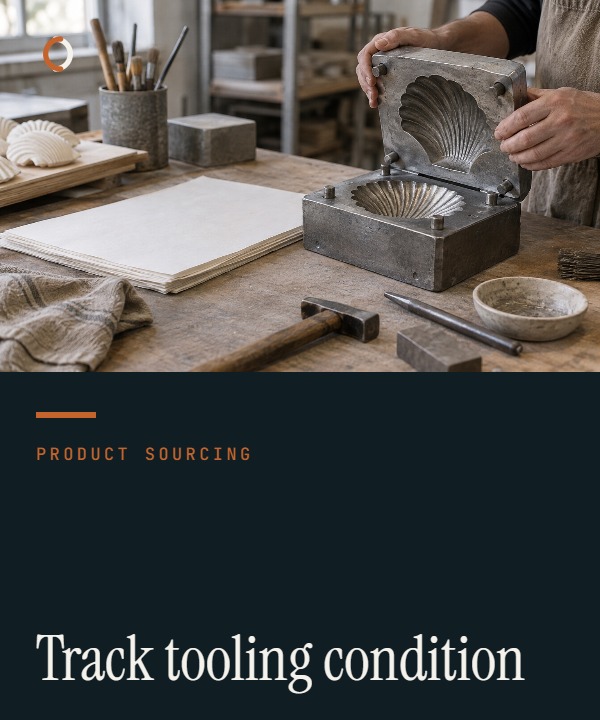
A mould and tooling condition log should answer a practical question before every production run: is this identified asset fit to enter the next controlled stage, and what evidence supports that decision?
The log is not merely a maintenance calendar. It connects tool identity, location, observed condition, measurements where meaningful, work performed, changes, evidence and release authority. That history matters when tooling sits at a supplier for months between orders or moves between sites.
For an Australian importer using supplier-held tooling in China, the log is the buyer's evidence bridge across distance and time. It helps the importer challenge a “tool is ready” message before releasing the next offshore production order, while leaving tool-specific inspection methods and acceptance decisions to qualified technical owners.
Separate ownership from condition
Tool ownership records answer who owns the asset, where it may be used and what happens if the supplier relationship ends. The condition log answers whether the asset remains identifiable, controlled and ready for work.
Keep the ownership agreement linked, but do not bury lifecycle records inside it. Use the China mould and tooling ownership guide for the commercial control, then give each physical tool its own permanent ID and history.
Start with a tool master record
Create one master record for each mould, die, jig, fixture, gauge or customer-funded item that needs control.
| Field | Purpose |
|---|---|
| Tool ID | Stable identifier used on the asset and every record |
| Description | Product, part and process served |
| Drawing/model revision | Connects tool to the controlled design baseline |
| Ownership and restrictions | Links to the agreement; does not restate it |
| Physical location | Supplier, site, building and storage area |
| Custodian | Person responsible for access and records |
| Commissioned date | Historical context, not a life prediction |
| Critical characteristics | Surfaces, dimensions or functions that affect output |
| Inspection method | How condition will be observed or measured |
| Current status | Available, due review, under repair, quarantined or retired |
Mark the physical asset with the same ID where practical. Photographs should show both the identifier and recognisable tool features so records cannot be reassigned casually.
Define inspection events
Do not wait for a defect dispute to reconstruct tool history. Set event-based checks appropriate to the tool and product, such as:
- on commissioning and acceptance;
- before a production run after storage;
- after the run and before preservation;
- after a breakdown, repair or engineering change;
- after transfer between sites or custodians;
- when condition evidence reaches a tool-specific trigger; and
- before return, disposal or retirement.
Avoid copying a universal interval from another factory. The tool designer, process specialist and supplier should set frequencies and methods using material, geometry, wear mechanisms, production history, storage environment, failure consequences and manufacturer recommendations.
Record condition in observable terms
Use a checklist tailored to the asset. For a mould, categories might include identity, cavity/core surfaces, parting line, slides, ejectors, vents, gates, cooling circuits, connectors, fasteners, corrosion protection and storage condition. A fixture or gauge needs a different list.
For each checkpoint, record:
- method—visual inspection, functional check, measurement or test;
- result—actual observation or value;
- acceptance basis—drawing, specification, approved sample, instruction or specialist decision;
- evidence—photo, report or data file reference;
- status—acceptable, monitor, repair, hold or not applicable; and
- reviewer and date.
ISO's educational audit guidance distinguishes monitoring a status from measuring a value. Both may be useful. Use measurement only where the method and equipment can provide a valid result.
Keep a maintenance and repair history
Every intervention should preserve the before-and-after trail.
| Record | Minimum useful detail |
|---|---|
| Trigger | Scheduled task, observed wear, defect, breakdown or change |
| Pre-work evidence | Condition photos, measurements and affected output |
| Authorised scope | Cleaning, repair, replacement, welding, polishing or change |
| Performer | Supplier team or approved external specialist |
| Parts/materials | Identified replacements and material where relevant |
| Post-work verification | Inspection, trial result, sample or measurement |
| Change link | Approved engineering-change reference if geometry or function changed |
| Release | Named authority, date and permitted next stage |
Routine cleaning should not obscure a repair. A repair should not be recorded as an engineering change unless the approved baseline changed, but any change to geometry, material, process or critical function needs the product change-control workflow.
Track use without inventing precision
Shots, cycles, hours or batches may help explain wear, but only if the counter is reliable and consistently tied to the tool. Do not create false precision from rough production estimates.
Record the source of the use figure, reset rules, missing periods and whether the figure covers the whole tool or a replaceable component. Use it as one input to review—not a universal end-of-life number.
Link tool condition to product evidence
A clean-looking mould can still produce unacceptable parts, and an old tool can still make conforming output. Tool condition and product conformity are related but distinct evidence streams.
After significant maintenance, repair, transfer or change, define what production evidence is required before normal release. Depending on risk, that could include a trial, dimensional report, approved sample comparison or first article inspection. The appropriate method and acceptance limits must come from the controlled product requirement and qualified technical owners.
Use clear status control
Use a small set of states that drive action:
- Available: required review is current and the tool may enter the next approved stage.
- Due review: evidence is incomplete or a planned check is due; production release is blocked until resolved.
- Under maintenance: work is authorised and in progress.
- Quarantined: condition is suspect or nonconforming; access and use are restricted.
- Retired: the tool is no longer approved for production and disposition is recorded.
Display the status on the physical tool or storage location where practical, but treat the controlled register as the source of truth.
A practical log entry
| Field | Example |
|---|---|
| Tool ID | MLD-042 |
| Event | Pre-run review after 11 weeks storage |
| Baseline | Tool checklist TC-07 Rev C |
| Findings | Light surface corrosion at identified insert; cooling check pending |
| Evidence | MLD-042-20260831-P01 to P06 |
| Action | Hold; clean insert and complete cooling-circuit test |
| Verification | Result and evidence added after work |
| Status | Due review / not released |
| Authority | Tooling engineer and buyer quality owner |
The example does not prescribe an acceptance decision. It shows how a finding becomes an owned action and a visible status.
Audit the log for weak signals
Review the history periodically for:
- repeated repair at the same feature;
- identical “OK” entries without evidence;
- long gaps in use or storage checks;
- changed locations without transfer records;
- maintenance followed by recurring product defects;
- missing links between changes and approved revisions;
- tool IDs that do not match photographs; and
- releases by people without defined authority.
These are prompts for investigation, not proof of supplier misconduct or tool failure.
The next-run decision
Before releasing the next order, confirm the tool identity and location, required review status, open maintenance or change actions, latest condition evidence and any product verification required after intervention.
If those elements are not traceable, the tool is not ready simply because the supplier says it is available. Hold the release, close the evidence gap and preserve the decision in the same log.
Sources
Not sure the supplier is real?
We check the factory before you pay: registry and litigation screening, a day on site at each shortlisted factory, and one written recommendation.
See how supplier vetting works →Get the goods checked before you pay the balance.
Our inspectors check production at the factory, mid-run and before shipment. They're paid by you, not the factory, so they work for you.
See quality control →Shipping from China to Australia?
We consolidate orders from several suppliers at our Guangzhou warehouse and coordinate the move with licensed forwarders, with one point of contact from factory to your warehouse.
See freight services →Need a factory that can make it?
We find and vet suppliers, including capable smaller factories that are more flexible on MOQ and terms, negotiate in Mandarin, and get samples to your desk before anything is committed.
See product sourcing →


