

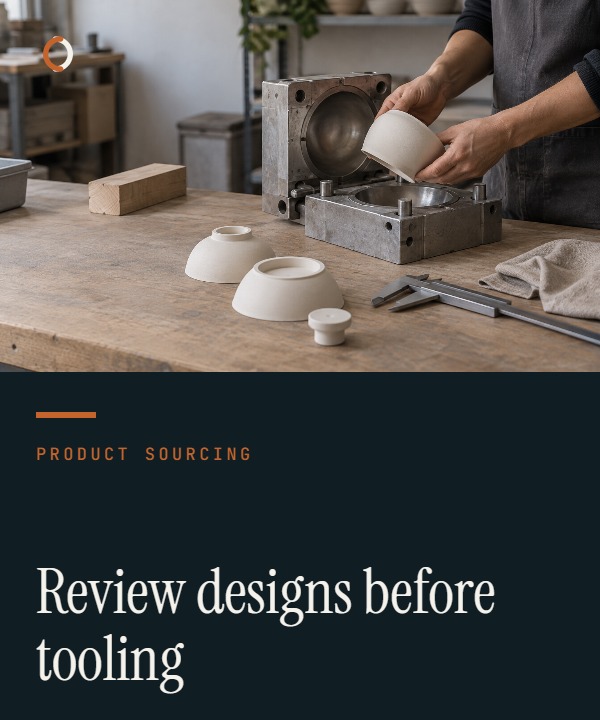
A design-for-manufacturability review should end with a controlled decision, not a vague message that the factory has “optimised” the product. Before tooling starts, record every factory concern against the current design revision, identify the requirement it affects, and choose one disposition: approve a documented revision, request more evidence, reject the proposal, or keep tooling on hold.
That is the useful boundary for an Australian importer. The factory can explain its equipment, process constraints and cost drivers. It cannot silently redefine the product you intend to sell. A DFM review also does not replace engineering, testing or Australian compliance work.
Treat DFM as a decision gate, not permission to change the design
The US National Institute of Standards and Technology describes DFM as bringing manufacturing considerations into design so manufacturing problems can be identified during the design stage. That timing matters: an early issue record preserves the option to revise the product or manufacturing route before a supplier interprets approval as authority to cut steel or commit other irreversible spend.
For an overseas buyer, the DFM gate has three jobs:
- expose features the proposed factory or process cannot make as currently defined;
- make the consequence of each proposed change visible across function, appearance, inspection, cost, timing and compliance; and
- create an attributable record of who accepted which revision and on what evidence.
Keep DFM separate from the earlier choice between OEM and ODM development. That choice establishes how much design control the buyer needs. The DFM review tests a defined product against a proposed manufacturing route.
Send a controlled input pack before asking for feedback
A useful review needs more than a rendering or an unlabeled CAD file. Send one revision-controlled pack and list its contents in the review request. Depending on the product and development stage, that may include:
- revision-labelled drawings or CAD files;
- the current product specification;
- a bill of materials where component identity matters;
- intended function, interfaces and critical-to-quality characteristics;
- approved appearance references and finish requirements;
- the proposed manufacturing process, target order volume and relevant assembly information; and
- open questions already known to the buyer or designer.
State which document controls if two files conflict. Also distinguish the requirement from one possible implementation. “Must withstand the validated service load” is a requirement; a particular rib shape may be only one proposed design response. The distinction gives the factory room to raise a legitimate concern without quietly trading away the intended outcome.
Ask the supplier to confirm the file names and revision identifiers it reviewed. If its report refers to an older model, stop and reissue the pack rather than trying to reconcile screenshots later.
Require one record for every manufacturability concern
Do not accept “DFM OK” as the full record. Current Protolabs material shows how a manufacturing analysis can identify required changes and flag feature-level issues such as undercuts, draft, surface finish, wall thickness and material flow. Those examples are process-specific prompts, not recommendations for your product. The transferable lesson is that every flag should point to an exact feature and a stated consequence.
Use one row per issue:
| Issue and source revision | Factory explanation and evidence | Buyer impact check | Disposition and owner |
|---|---|---|---|
| Exact part, feature, drawing zone or requirement | Process constraint, proposed change and supporting markup, simulation, trial or machine/tool information | Function, appearance, inspection, compliance, cost, timing, packaging or assembly affected | Approve revision, request evidence, reject or hold; named buyer and technical owner |
| Claimed cost or cycle alternative | Current and proposed scope, assumptions and quote effect | Is this required to manufacture, or a commercial option? | Commercial review separate from technical acceptance |
| Ambiguous deviation | Supplier marks the difference against the controlled file | Cannot assess until the delta is explicit | Hold; supplier to resubmit |
Screenshots can help locate a concern, but they should not become an uncontrolled substitute for the drawing, CAD model or specification. Give each issue an identifier and keep the supporting file with that record.
Classify the decision before debating the solution
The first question is not “Do we like the factory's idea?” It is “What kind of decision is this?” A simple classification stops mandatory constraints, optional improvements and price negotiations being bundled into one apparent technical approval.
Required to manufacture
The supplier says it cannot make the current definition with the proposed process or equipment. Require it to identify the blocking feature, why it blocks production, which input assumption it used and what alternatives it can support. The buyer then decides whether to change the design, change the process, seek another supplier or commission qualified technical work.
Advisory improvement
The current design may be manufacturable, but the supplier predicts a risk to consistency, appearance, inspection, yield or tool maintenance. Ask what evidence distinguishes the current and proposed options. An advisory label is not proof, and a lower-risk design claim still needs the right reviewer.
Commercial alternative
The factory can make the design but proposes a different material, feature, finish, assembly method or tool concept to affect price, lead time or minimum order quantity. Treat this as a scoped alternative. Compare it with the controlled requirement and revised commercial offer; do not let a cheaper quote become an undeclared design change.
If the supplier cannot classify the concern clearly, leave the issue open. Ambiguity is a reason to hold, not a compromise disposition.
Test the proposal against the product intent
An apparently small manufacturing change can touch several controls. Review the delta, not just the factory's summary. At minimum, ask:
- Does the change affect intended function, load, fit, interface or assembly?
- Does it alter a critical-to-quality characteristic or how that characteristic can be inspected?
- Will users see or feel a different surface, colour, seam, mark or alignment?
- Does it change material identity, component identity, labelling, packaging or instructions?
- Could it affect existing safety, regulatory or test evidence?
- Does it create a new defect mode or make an existing defect harder to detect?
This is a routing checklist, not an engineering method. Material selection, tolerances, structural performance, electrical design, tool construction and safety-critical decisions require a suitably qualified reviewer. If that person is unavailable, the article's process leads to a hold.
Product Safety Australia specifically warns about retesting after design, material or production changes. Therefore, a factory DFM sign-off must not be treated as proof that the changed product remains safe or compliant. Identify the applicable Australian requirements and decide what must be rechecked before accepting the revision.
Close the commercial consequences at the same time
A technically acceptable proposal can still create an unacceptable project. For every accepted or shortlisted change, read back the commercial delta:
- revised unit price and the assumptions behind it;
- tooling scope, price, ownership, maintenance and modification responsibility;
- prototype or sample rounds and who pays for them;
- testing, inspection or requalification work;
- production lead time, tool lead time and capacity assumptions; and
- minimum order quantities, order multiples or component commitments.
Keep the technical disposition and commercial acceptance as separate fields. That prevents a buyer from approving a geometry investigation and later discovering that the supplier treated it as approval of a new tool or price.
If buyer-funded tooling is involved, apply the records and access controls in OPL's guide to mould and tooling ownership in China. The DFM record should identify the accepted tool input revision; the tooling record should control what is built, paid for and owned.
Update the controlled design before any tooling release
ISO's current guidance on documented information for ISO 9001:2015 lists records of design inputs, controls, outputs and changes, including review results and authorisation. An importer does not need to claim ISO certification to adopt that sensible discipline.
Once a proposal is accepted:
- update the affected CAD, drawing, specification and bill of materials under a new revision;
- link the revised file to the closed DFM issue;
- record any approved deviation that does not change the master file;
- obtain the revised quotation, sample plan and test or inspection requirements;
- ask the supplier to read back the exact revision it will use; and
- record the named technical and commercial authorisers.
Do not close an issue with “agreed on call”. Capture the decision and the changed requirement. A permanent accepted change belongs in the controlled master files. If a temporary, bounded deviation is necessary, identify its exact scope, affected sample or lot, expiry and authoriser rather than allowing it to become an undocumented alternative design. If the factory sends a fresh model after the meeting, compare it with the accepted revision before release.
Verify the change in a representative sample
The DFM gate releases a design for the next controlled step; it does not prove the resulting product. Select the appropriate stage using the guide to product samples from China, and define the evidence needed for each accepted issue.
That evidence might be a measurement against a controlled characteristic, an assembly check, a surface comparison, a functional test or a product-specific laboratory result. The correct method and acceptance criteria depend on the product. Where safety, performance or compliance is involved, use the responsible qualified reviewer and applicable current requirements.
Move accepted characteristics into the quality control plan. If a later supplier proposes another material, process or feature change, route it through the formal product change-control workflow rather than relying on the old DFM email.
Run the final pre-tooling release check
For this workflow, a tooling-critical issue is one whose resolution can change the geometry, material, interface, critical requirement or other input used to design, order or modify the tool. Release the affected tooling only when the project can answer yes to each applicable question:
- Did the supplier review the current, identified input pack?
- Does every concern identify an exact feature or requirement?
- Is each proposed change classified as required, advisory or commercial?
- Have function, appearance, inspection, assembly, packaging and compliance consequences been routed to the right owners?
- Have qualified reviewers approved technical or safety-critical changes?
- Are revised price, tooling, sample, test and timing effects recorded?
- Do the master files show one accepted revision?
- Has the supplier read back that revision?
- Are all tooling-critical issues closed, with no vague concessions?
- Is the post-tool sample and verification plan defined?
If any answer is no, record the owner and due date and keep the affected release on hold. The result is not slower decision-making. It is a clear boundary between useful factory feedback and an uncontrolled product change.
Sources
Not sure the supplier is real?
We check the factory before you pay: registry and litigation screening, a day on site at each shortlisted factory, and one written recommendation.
See how supplier vetting works →Get the goods checked before you pay the balance.
Our inspectors check production at the factory, mid-run and before shipment. They're paid by you, not the factory, so they work for you.
See quality control →Shipping from China to Australia?
We consolidate orders from several suppliers at our Guangzhou warehouse and coordinate the move with licensed forwarders, with one point of contact from factory to your warehouse.
See freight services →Need a factory that can make it?
We find and vet suppliers, including capable smaller factories that are more flexible on MOQ and terms, negotiate in Mandarin, and get samples to your desk before anything is committed.
See product sourcing →


